Howdy, pilgrim! You're in the ^zhurnal — since 1999, a journal of musings on mind, method, metaphor, and matters miscellaneous — previous volume = 0.9952.For the whole ZhurnalyWiki in TiddlyWiki form, load https://zhurnaly.tiddlyhost.com/ (~20MB, may take a few seconds) — a backup copy is at http://zhurnaly.com/zhurnalywiki.html (may be a few months old). For static snapshots of the ZhurnalyWiki's ~9,000 individual pages, see http://zhurnaly.com/z/.
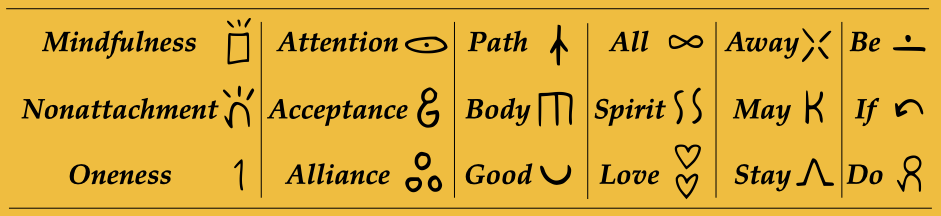
For Mindfulness + Nonattachment + Oneness Insight suggestions see https://insight.tiddlyhost.com/ — a backup copy is at https://zhurnaly.com/insight/. For physical Insight Cards (and Dice!) see Insight. Thank you!
A beautiful metaphor for a good together life, from a New York Times interview "The Grody-Patinkin Family Is a Mess. People Love It." – Mandy Patinkin:
"I wish for everyone to have a companion to go through life with, to do nothing with, to have in the other room. You don’t have to be married, but someone who, when you meet, you feel something that you cannot put into words. That is what you should hope and pray for and be available to the possibility of taking place in your existence."
... and spouse Kathryn Grody:
"... the comfort of just having somebody you know really well, and we’re sharing the same space but very comfortably being each other’s body in the other room."
... and in Toki Pona, perhaps:
mi wile la, jan ale li jo e jan pona poka
| toki pona | loose translation |
|---|---|
| mi wile la, jan ale li jo e jan pona poka | my wish is for everyone to have a good person nearby |
(cf Patient Companionship (2008-07-06), Unconditional Friendliness (2018-08-10), ...) - ^z - 2025-07-14
- Monday, July 14, 2025 at 07:54:30 (EDT)
Thoughts from a New York Times conversation "Why Does My Mind Keep Thinking That?" between columnist Ezra Klein and author psychotherapist Buddhist teacher Mark Epstein:
Holding the Other with an open hand allows space around both of you so that there’s room for the inevitable moving away.
which comes from the metaphor credited to Stephen Batchelor:
... [the] difference between holding a coin in a clenched fist and holding it with an open palm.
... or in Toki Pona, perhaps:
jo e jan ante kepeken luka suwi la, sina pana e weka tawa sina tu
| toki pona | loose translation |
|---|---|
| jo e jan ante kepeken luka suwi la, sina pana e weka tawa sina tu | holding the other person with a soft hand, you give room to both of yourselves |
... and:
o jo ale insa luka suwi a
| toki pona | loose translation |
|---|---|
| o jo ale insa luka suwi a | hold everything in a soft hand! |
(cf Mantra - Let It Go (2014-12-27), Mantra - Mindfulness, Nonattachment, Oneness (2017-01-25), Hanson on Letting Go (2018-01-17), ...) - ^z - 2025-07-12
- Saturday, July 12, 2025 at 14:48:28 (EDT)
"Learning Power" — a concept that deserves reflection and thought, especially in these days of Large Language Models and Generative AI and humans searching for meaning in life. Especially valuable, the alliterative taxonomy of learning power capacities from Guy Claxton's 2002 book Building Learning Power:
... or in Toki Pona, perhaps in brief:
lon wawa
lon sona
lon kulupu
lon mi
| toki pona | loose translation |
|---|---|
| lon wawa | being strong |
| lon sona | being wise |
| lon kulupu | being social |
| lon mi | being ourselves |
(cf Hare Brain, Tortoise Mind (2005-06-03), The Heart of Buddhism (2015-01-10), Equanimity and Magnanimity (2015-02-19), Mantra - Be on Good Form (2016-05-10), ...) - ^z - 2025-07-08
- Tuesday, July 08, 2025 at 08:15:03 (EDT)
Thoughtful remarks by filmmaker Ken Burns, as quoted in Maureen Dowd's New York Times op-ed essay of 5 July 2025:
“The best arguments in the world won’t change a single person’s point of view,” he said. “The only thing that can do that is a good story. Good stories are a kind of benevolent Trojan horse. You let them in, and they add complication, allowing you to understand that sometimes a thing and its opposite are true at the same time.”
Burns told us that his half-century of making documentaries about America’s wars and pastimes has taught him to embrace contradictions. “The binaries that we set up are the biggest trap, whether they come from the left or the right,” he said. “When you see somebody making a ‘them,’ you have to be careful. That’s antithetical to what the Declaration is saying. I hope that what we do on the Fourth of July is try to put the ‘us’ into the U.S.”
... and ...
... or in Toki Pona, perhaps the key concept:
tenpo lon la, ijo en ijo ala li lon tu
| toki pona | loose translation |
|---|---|
| tenpo lon la, ijo en ijo ala li lon tu | times exist, when thing and not-thing are both true |
(cf Opposite Thinking (2000-03-16), Franklin on Dogmatism (2008-08-12), ...) - ^z - 2025-07-06
- Sunday, July 06, 2025 at 10:53:07 (EDT)
George Carlin:
“There are nights when the wolves are silent and only the moon howls.”
... or in Toki Pona, perhaps:
tenpo mun li lon la soweli suli li mu ala
taso mun li kalama
| toki pona | loose translation |
|---|---|
| tenpo mun li lon la soweli suli li mu ala | nights exist when great animals are quiet |
| taso mun li kalama | but the moon cries out |
(cf Full Moon Metaphors (2007-10-29), Moon Over Water (2012-02-12), Half Moon Makes Full Halo (2013-04-29), Mantra - Go for the Moon (2016-07-18), ...) - ^z - 2025-07-04
- Friday, July 04, 2025 at 08:54:44 (EDT)
James Marriott's op-ed essay "Not reading or writing would be unthinkable" of 23 June 2025 is subtitled "The evidence is clear: those who don’t read or who outsource their essays to AI lose the facility for complex thought". Key excerpts: Writing is the most reliable (and often the most painful) method our species has devised of transforming half-formed notions and stray fancies into rigorous, logical thought. I cannot be the only opinion columnist to have discovered that ideas that sounded impressive when I was declaiming them in the pub have a habit of looking lame and illogical when transferred to that most stark and inhospitable of environments, the blank page. Ah… perhaps that’s not what I think, after all. Time to try again. ... [Walter Ong] observed that oral cultures — which lack writing and thus communicate only through speech — must devote enormous cognitive energy to preserving knowledge. If you can’t write anything down, the only way to retain information is to remember it. Inevitably, this takes up vast intellectual resources and limits both the quantity and the quality of available thought. To preserve knowledge you must “think memorable thoughts”; if a thought is not memorable it will eventually disappear. Oral cultures thus rely on rhyme, metre, cliché formulations, strong emotion and outlandish characters to fix information in the minds of listeners. Such societies are good at producing epic poems of heroes and monsters, but they tend not to produce masterpieces of analytic philosophy. Importantly, Ong argued, speech is ephemeral and imprecise. Spoken sentences cannot be refined and redrafted for maximum precision before being presented to an audience. And they disappear the moment they have been uttered. By contrast, the invention of writing allows authors to formulate complex and precise statements; readers can then reflect on them, interrogate them and add to them, building ever more complex and abstract ideas of their own. Writing also favours logical argument over mere assertion — a written text allows us to flit back and forward as we read, to check if an argument is proceeding logically. In a book it looks weird if the author flatly states something to be true and then rushes off to an unconnected thought, though the habit is quite normal in conversation. The advent of literacy vastly expanded both the quality and quantity of thoughts available to our species.
... or in Toki Pona, perhaps, in summary:
jo sona li pali mute li pona suli
sitelen li pana wawa tawa jo sona
| toki pona | loose translation |
|---|---|
| jo sona li pali mute li pona suli | getting knowledge is much work and is hugely important |
| sitelen li pana wawa tawa jo sona | symbols give power to getting knowledge |
(cf Writing Rewards (2001-06-09), Better Writing (2003-05-16), Dangerous Literature (2006-03-03), Worth Writing Well (2016-08-17), ...) - ^z - 2025-07-01
- Tuesday, July 01, 2025 at 09:38:13 (EDT)
Melissa Kirsch's essay, in the New York Times morning newsletter of 28 June 2025, suggests honoring this season via mid-year "Resolutions". It concludes:
... A friend recently told me she’d resolved to ask “Does this make my life bigger?” before she made any decision. I might try this one. You might resolve to spend more time with people around whom you feel like the best version of yourself. Let the resolutions be additive, celebratory, exciting. Make them about increasing joy, about being new and radiant and more enthusiastic about the things and people you love. Happy New Half of the Year. Let’s make it the best half yet.
... and in Toki Pona, perhaps some similar thoughts:
ni la, lon mi li suli ala suli
mi wile awen pi tenpo suli poka jan pi pona suli
mi wile pilin pona a, pilin sin a, pilin suno a, pilin wawa a
| toki pona | loose translation |
|---|---|
| ni la, lon mi li suli ala suli | in this context, is my life larger? |
| mi wile awen pi tenpo suli poka jan pi pona suli | i wish to stay long near people of great goodness |
| mi wile pilin pona a, pilin sin a, pilin suno a, pilin wawa a | i wish to feel good, to feel new, to feel sunny, to feel strong |
(cf New Year Resolution (2007-01-04), Soul Resolutions (2023-01-01), ...) - ^z - 2025-06-30
- Monday, June 30, 2025 at 10:59:26 (EDT)
A saying by Robert Brault, shared by Living Compassion:
Today I bent the truth to be kind and I have no regret, for I am far surer of what is kind than I am of what is true.
... or in Toki Pona, perhaps:
tenpo mute la mi sona e pona
taso tenpo mute la mi sona ala e lon
ni la mi wile lon e pona
| toki pona | loose translation |
|---|---|
| tenpo mute la mi sona e pona | often i know what is kind |
| taso tenpo mute la mi sona ala e lon | but often i do not know what is true |
| ni la mi wile lon e pona | thus, i strive to be kind |
(cf Become Softer (2017-05-25), Be the Gateless Gate (2019-03-06), Be Kind (2021-02-27), ...) - ^z - 2025-06-29
- Sunday, June 29, 2025 at 07:27:23 (EDT)
Some of the key points of Cory Doctorow's 2024 essay "No One Is the Enshittifier of Their Own Story " are summarized in his paragraph:
In Toki Pona, perhaps part of this could be rendered:My early writings on enshittification focused on its symptoms, the way platforms decay. The progression of the disease looks like this: First, companies are good to their users. Once users are lured in and have been locked down, companies maltreat those users in order to shift value to business customers, the people who pay the platform’s bills. Once those business users are locked in, the platform starts to turn the screws on them, too – extracting more and more of the value generated by end-users and business customers until all that remains in the meanest residue, the least amount of value that can keep everyone locked into the platform.
kulupu esun sona sin li kama e ko jaki tan seme
tenpo wan la ona li pona
taso jan kepeken ona ken ala weka la kulupu esun sin li pali e ike tawa jan ni
ona li pana e mani mute tawa kulupu esun kepeken
taso esun kepeken ni ken ala weka la kulupu esun sin li pali e ike tawa ni
kulupu esun sin li jo e mani ale tawa ona
ni li ike
| toki pona | loose translation |
|---|---|
| kulupu esun sona sin li kama e ko jaki tan seme | why do new technology companies become poopy? |
| tenpo wan la ona li pona | initially, they are good |
| taso jan kepeken ona ken ala weka la kulupu esun sin li pali e ike tawa jan ni | but when their human users cannot leave, the new companies act bad to those people |
| ona li pana e mani mute tawa kulupu esun kepeken | they give a lot of money to business users |
| taso esun kepeken ni ken ala weka la kulupu esun sin li pali e ike tawa ni | but when those business users cannot leave, the new companies act bad to them |
| kulupu esun sin li jo e mani ale tawa ona | the new companies take all the money for themselves |
| ni li ike | this is bad |
(cf For Themselves (2003-06-08), Do the Right Thing Well (2016-01-12) ...) - ^z - 2025-06-27
- Friday, June 27, 2025 at 08:14:40 (EDT)
The conclusion of a lovely obituary for pianist Alfred Brendel (1931-2025) in The Times of London:
Brendel was an artist with greater charm in private than in public, who seemed an unlikely superstar in an age that often favoured dazzle and bravura over gravitas and determination. He could be nervous, jittery even. Being neither a perfectionist nor a virtuoso, he had to fight for each piece. However, his strength came directly from that struggle. Nevertheless, in his continual search for musical truth he never heard a performance that completely satisfied him, and never played one that completely satisfied him either. In keeping with his love of the absurd and, in a sense, answering his own question about whether or not classical music should be serious, he enjoyed pointing out that the word “listen” is an anagram of “silent”.
... some of which, perhaps, could be said in Toki Pona:
jan ni li pali e kalama musi suwi
ona li ante e jan mute pi kalama musi
ona li pali suli wawa
kute kalama musi la ona li pilin ala e pona ale tawa ni
ona li olin e nasa
ni la ona li toki musi tawa kalama musi
| toki pona | loose translation |
|---|---|
| jan ni li pali e kalama musi suwi | this person made sweet music |
| ona li ante e jan mute pi kalama musi | he differed from many musicians |
| ona li pali suli wawa | he worked long and hard |
| kute kalama musi la ona li pilin ala e pona ale tawa ni | when listening to music, he never felt totally good about it |
| ona li olin e nasa | he loved the strange |
| ni la ona li toki musi tawa kalama musi | in that context, he joked about music |
... not as poetic as the English version, alas!
(cf Buechner Magic (2000-10-27), Remember Rafe (2000-12-11), Music Master (2001-06-04), Webb Wiggins (2002-12-15), Artistry at the Piano (2005-11-08), ...) - ^z - 2025-06-25
- Wednesday, June 25, 2025 at 06:54:17 (EDT)
Dannagal Young's essay "Holy Water Couldn’t Save My Husband. MAHA Wouldn’t Have, Either." (gift link) is a well-written and tragic essay about our powerful natural tendency to want to do something immediate — rather than study and learn and weigh evidence and build models and think probabilistically. The key point:
… Looking to magic and intuition for agency in a moment when science and medicine are frustrating is normal and human. But I worry that these normal human impulses are being exploited by powerful people who would rather a desperate wife carry a heart-shaped rock in her pocket than allow the government to support the very research that could actually treat or cure brain tumors like Mike’s. …
... alternatively, perhaps, in Toki Pona:
mi wile e pona
mi wile pali e ijo
taso pali nasa li lon wawa ala
sona suli li wawa
| toki pona | loose translation |
|---|---|
| mi wile e pona | we want the good |
| mi wile pali e ijo | we want to do something |
| taso pali nasa li lon wawa ala | but doing weird things is not strong |
| sona suli li wawa | knowledge is strong |
(cf Science and Pseudoscience (2001-10-06), Altered Native (2002-01-24), No Final Answers (2002-03-11), Evidence-Based Medicine (2010-01-16), Medicine and Statistics (2010-11-13), ...) - ^z - 2025-06-21
- Saturday, June 21, 2025 at 07:36:05 (EDT)
| Move the Horizon Closer |
... a sweet suggestion by Melissa Kirsch in her 2025-06-14 New York Times morning email newsletter essay "Breathing Room". The last paragraph summarizes:
and perhaps in other words:A wise friend advised me when I was worrying recently to “move the horizon closer.” I love this. My eyes are always cast on some distant point in the future. Moving the horizon closer means to keep my thoughts and fantasies and fears contained to this plane, this moment, without spinning out into the atmosphere. The here and now is all we have, and it’s a lot, for everyone. You don’t have to consult an oracle to know this. But the reminder is useful: Where are you right now? What is happening in that space, in that moment? How can you inhabit it fully? How can you move the horizon closer?
o poka e selo ma sewi
| toki pona | loose translation |
|---|---|
| o poka e selo ma sewi! | O make-near the land-sky boundary! |
(cf Larger Inside (2004-05-11), Seeing Nature (2005-07-19) Embrace Tiger, Return to Mountain (2014-01-18), Mantra - Mind Like Sky (2016-02-29), ...) - ^z - 2025-06-15
- Sunday, June 15, 2025 at 09:17:43 (EDT)
Amanda Ripley suggests in a Washington Post essay that the real sources of most human conflict are found among psychological needs or fears:
Interesting, though non-orthogonal, dimensions — further study and quantitative systems analysis needed! And meanwhile, in Toki Pona, perhaps the above might be summarized:
pilin lukin
pilin wawa
pilin olin
pilin monsuta
| toki pona | loose translation |
|---|---|
| pilin lukin | feeling seen |
| pilin wawa | feeling strong |
| pilin olin | feeling loved |
| pilin monsuta | feeling scared |
(cf Ethical Fitness (2000-12-15), Best Self (2013-12-14), Big Five (2018-03-26), Humility, Learning, and Respect (2021-01-28), ...) - ^z - 2025-06-12
- Friday, June 13, 2025 at 08:49:39 (EDT)
Harlan Howard (1927-2002) described Country Music as "Three chords and the truth" ... in Toki Pona:
kalama tu wan en lon li pali e kalama musi ma
... or:
| toki pona | loose translation |
|---|---|
| kalama tu wan en lon li pali e kalama musi ma | Three sounds and reality make the music of the land |
(cf Meditation - Sound, Music, Silence (2014-10-06), Mantra - Notice the Music (2014-12-06), Winter's Tale on Music Everywhere (2014-12-23), ...) - ^z - 2025-06-03
- Tuesday, June 03, 2025 at 07:34:25 (EDT)
In Toki Pona, the chorus of the song "Story of My Life" by Social Distortion:
tenpo sina li lon lili a
sina wile taso pali e pona
lape la tenpo sina li weka
ni li lon e kon mi
... that is:
| toki pona | loose translation |
|---|---|
| tenpo sina li lon lili a sina wile taso pali e pona lape la tenpo sina li weka ni li lon e kon mi | Your time is short! You want only to do good Sleeping, your time is gone That is my essence |
... the original, in English:
Life goes by so fast
You only want to do what you think is right
Close your eyes and it's past
Story of my life
(cf Story of My Life (2016-03-04), ...) - ^z - 2025-06-01
- Sunday, June 01, 2025 at 07:18:33 (EDT)
Crochet is not about transforming strings into things – it's about creating holes in a good pattern!
o ante ala e linja tawa ijo
o pali e lupa pona
that is:
| Toki Pona | loose translation |
|---|---|
| o ante ala e linja tawa ijo o pali e lupa pona | Change not flexible-stuff into objects! Make holes of goodness! |
(cf Between (2009-12-10), Cling to Nothing (2011-01-29, ...) - ^z - 2025-05-30
- Friday, May 30, 2025 at 08:26:38 (EDT)
Best bits from Paul Krugman's "A Conversation With Barry Ritholtz" (24 May 2025) – quotes from Mr Ritholtz, author of How Not to Invest:
And perhaps most important for living a Good Life:
I define wealth as the freedom to do what I want. Yes, we want security. Yes, we want to know that our loved ones are taken care of. But if it means you don't have the time to spend with friends and family, if it means that you're grinding away on something that makes you miserable, well, you have a lot of money. But to me, that doesn't define wealthy. Wealth is agency and the ability to determine how you live your life. And we very often take that for granted. That is much more valuable.
Listen. A human being's stock in currency is time, and how you spend your time is, probably, when you're younger you trade your time for money. When you get older you start trading your money for time. You may have a lot of money, but we all have a finite amount of time before we join the choir invisible. Wealth really reflects spending that time well.
(cf Thinking, Fast and Slow (2013-10-24), How NOT to Invest (2025-04-03), ...) - ^z - 2025-05-29
- Thursday, May 29, 2025 at 08:41:06 (EDT)
"What I've Learnt suggestions from British writer and broadcaster Gyles Brandreth, age 77:
(cf Bennett on Life (2000-03-09), Practical Productivity (2004-01-20), How to Succeed (2005-03-11), Retirement Mental Health Advice (2023-05-25), Eight Life Goals (2023-07-20), ...) - ^z - 2025-05-27
- Tuesday, May 27, 2025 at 07:01:47 (EDT)
Lovingkind thoughts from New York Times columnist David French, in his essay "Were You Raised in a Church That Fears the World or Loves Its Neighbors?":
When I talk to Christians who are struggling with their faith, one of the first things I ask them is, “Were you raised in a fear-the-world church or a love-your-neighbor church?” Most people instantly know what I’m talking about. The culture of the church of fear is unmistakable. You’re taught to view the secular world as fundamentally a threat. Secular friends are dangerous. Secular education is perilous. Secular ideas are bankrupt. And you’re always taught to prepare for the coming persecution, when “they” are going to try to destroy the church. The love-your-neighbor church is fundamentally different. It’s so different that it can sometimes feel like a different faith entirely. The distinction begins with the initial posture toward the world — not as a threat to be engaged, but as a community that we should love and serve. ... To be raised in a fear-the-world church is to experience a Christianity that declares with its words that the Resurrection is real, but seems incredulous about the possibility of a resurrection within its heart. If Christians truly can declare: “Where, death, is your victory? Where, death, is your sting?” then why is there such pervasive fear? Another way to describe a love-your-neighbor church is to say that it embraces a resurrection faith. Its aim is to follow Christ’s consistent pattern of moving to the suffering, the alienated and the sick, all to bring life from death. We cannot, of course, exercise Christ’s literal power over death. We cannot declare, as Christ did to Lazarus, “Come forth,” and watch our loved ones walk out of the tomb. But we can try to heal, to care for the physical needs of suffering people, and we can be instruments of grace to those dying from different kinds of deaths — spiritual, emotional and social. We live in a time of great anger. We live in a time of great pain. And everywhere we look we seem to see people of faith stoking anger and inflicting pain. But a resurrection church that follows a resurrected savior should be a balm, not a blowtorch. It will never be perfect, of course, but its fundamental orientation isn’t toward protecting itself, but toward serving others. Its default posture toward difference isn’t suspicion, but affection.
(cf My Religion (2000-11-06), Religion and Reverence (2001-07-08), Life Is Hard, and It's OK (2022-03-04), Friendship (2023-09-28), Classical Virtues (2024-04-14), John Hussman on Our Common Humanity (2025-04-17), ...) - ^z - 2025-04-21
- Monday, April 21, 2025 at 09:45:41 (EST)
John P. Hussman, a financial advisor and philanthropist, writes thoughtfully and with lovingkindness. In "An Abrupt and Cascading Dislocation" (16 April 2025) his commentary on irrational exuberance in the stock market concludes with remarks about society:
Because silence can be equal to consent, I’ll add that these unfavorable market conditions are joined by other observable elements that are deeply troubling in my view: the rapid descent of the U.S. toward an autocracy that normalizes the unchecked abuse of power; dispenses with the rule of law, due process, and human rights; dismantles democratic institutions; replaces career civil servants with loyalists; systematically defunds public health research and disease surveillance; retaliates against critics; raises barriers to access of Social Security offices and earned benefits; pressures law firms not to represent clients; exploits every opportunity for self-dealing; defunds universities, purges libraries, and whitewashes museums of so-called “improper ideology”; maligns journalists and bars access to news organizations that resist absurd demands; abandons, betrays, and disparages allies; openly seeks to annex sovereign countries; floods public dialogue with disinformation, grievance, fear, division, and false narratives; expels independent Inspectors General along with the capacity of the public to demand accountability; and deliberately erodes constitutional constraints in favor of personal dictate. Perhaps the escalating risk of a market crash and cascading economic dislocation isn’t surprising after all. We’re more than this. More than our division. More than the blame we cast on the other “side.” All of us are made of this shared substance of common humanity. The tragedy is that in our anger, we can’t see it – only us versus them. As my beloved friend and teacher Thich Nhat Hanh often said, “Enlightenment is the moment a wave recognizes that it is the water.” Our enemy isn’t each other – even the people we blame for all of our own suffering since the time we were 5 years old have suffered themselves since the time they were 5 years old. The blame falls to hatred, injustice, and ignorance themselves; the greed, violence, abuse, and lack of compassion that come from our illusion that “we” and “them” are separate; the failure to even consider how the other side has suffered – something both liberals and conservatives share; and worst, the destructive impulse to eliminate everything – even human beings – that we associate with the other “side.” All of us risk falling into that trap, and we can see our way out. If we have the insight to see that the other person also suffers, we know better what to do, and what not to do, to go forward. Look, I’ll speak out and fight against hatred, division, avarice, corruption, and injustice all day long. But it’s those elements, not human beings, that are the enemy. I hope others do the same, but also always considering the suffering of the other “side.” Even those who fight for the dignity and equality of others – especially those who are different – have to be mindful enough to see the moment when others feel threatened that those differences will overwhelm their way of life. When any side goes unheard for too long, their response is often to destroy, even without considering the consequences. My concern is that it’s happening within our government and nation right now. Despite our differences, and a thousand failures to become “a more perfect union,” we still have the capacity to listen to each other and work together to solve problems. We still have the chance to preserve a United States of America that dignifies the patriots who sacrificed their lives for this precious democracy – this Constitutionally based republic – without dispensing with “democracy,” or “Constitution”, or “United.” In our anger and division, we are further along the path of losing that precious inheritance than we may want to admit.
(cf Education, Culture, and Blame (2000-06-01), Aikido Spirit (2003-12-09), Ground of Being (2013-10-03), Gentleness, Sensitivity, Compassion (2014-03-09), Irrational Exuberance (2021-08-13), ...) - ^z - 2025-04-17
- Friday, April 18, 2025 at 06:38:07 (EST)
The Shema — one of the oldest prayers in the world — begins:
שְׁמַע יִשְׂרָאֵל יְהוָה אֱלֹהֵינוּ יְהוָה אֶחָד
... or in English, "Hear, O Israel: G‑d is our L‑rd, G‑d is one", pronounced in Hebrew, "Sh'ma Yisrael, Adonai Eloheinu, Adonai Echad".
Like Ho'oponopono, the Shema is mentioned in an episode of the multipart medical drama "The Pitt". In Toki Pona, perhaps it could be said:
o kute
... or phonetically, "o kute! sewi li ale, sewi li wan" — a reminder and affirmation of the largest and most important things in the Universe!
sewi li ale
sewi li wan
(cf My Religion (2000-11-06), 2008-03-23 - Sunrise Service at Seneca Creek, Tikkun Olam (2019-12-11), ...) - ^z - 2025-04-16
- Wednesday, April 16, 2025 at 09:21:58 (EST)
- I Love You
- Thank You
- I Forgive You
- Please Forgive Me
... elements of Hoʻoponopono – "a traditional Hawaiian practice of reconciliation and forgiveness". It was mentioned, in the presence of death, during an episode of the brilliant 2025 medical drama "The Pitt".
Something to think about and practice!
And in Toki Pona, perhaps:
(cf the Highly Reasonable blog entry of 2025-03-14, This Is Water (2009-05-21), Core Buddhism (2011-10-17), Cup Full of Love (2021-08-02), Genuine, Gallant, Generous, Grateful, Good (2023-09-16), ...) - ^z - 2025-04-09
- Wednesday, April 09, 2025 at 07:08:02 (EST)
“Do you even FRED, bro?” asked Paul Krugman in an NY Times column a few years ago. FRED is the nickname of the "Federal Reserve Economic Data" tool – a marvelous interactive system provided by the US Federal Reserve Bank of St Louis. FRED lets you quickly display and analyze economic information, combine multiple time series, generate graphs, and actually understand large-scale trends worth celebrating (or worrying about). An awesome free service to help the world think better!
(cf ^z FRED graphs, the NY Times Jeanna Smialek's article "Everybody Loves FRED: How America Fell for a Data Tool", Basement Worries (2002-06-15), Supply and Demand (2005-09-13), Folk Economics (2022-02-22), ...) - ^z - 2025-04-08
- Tuesday, April 08, 2025 at 08:41:55 (EST)
A new (March 2025) book by Barry Ritholtz, How NOT to Invest, is summarized by the author in his blog post 10 Biggest Ideas in “How NOT to Invest”. Slightly abridged:
1. Poor Advice: Why is there so much bad advice? The short answer is that we give too much credit to gurus who self-confidently predict the future despite overwhelming evidence that they can’t. We believe successful people in one sphere can easily transfer their skills to another – most of the time, they can’t. ... 2. Media Madness: Do we really need 24/7 financial advice for our investments we won’t draw on for decades? Why are we constantly prodded to take action now! when the best course for our long-term financial health is to do nothing? ... 3. Sophistry: The Study of Bad Ideas: Investing is really the study of human decision-making. It is about the art of using imperfect information to make probabilistic assessments about an inherently unknowable future. This practice requires humility and the admission of how little we know about today and essentially nothing about tomorrow. Investing is simple but hard, and therein lies our challenge. 4. Economic Innumeracy: Some individuals experience math anxiety, but it only takes a bit of insight to navigate the many ways numbers can mislead us. It boils down to context. We are too often swayed by recent events. We overlook what is invisible yet significant. We struggle to grasp compounding – it’s not instinctive. We evolved in an arithmetic world, so we are unprepared for the exponential math of finance. 5. Market Mayhem: As investors, we often rely on rules of thumb that fail us. We don’t fully understand the importance of long-term societal trends. ... 6. Stock Shocks: Academic research and data overwhelmingly reveal that stock selection and market timing do not work. ... 7. Avoidable Mistakes: Everyone makes investing mistakes, and the wealthy and ultra-wealthy make even bigger ones. We don’t understand the relationship between risk and reward; we fail to see the benefits of diversification. Our unforced errors haunt our returns. 8. Emotional Decision-Making: We make spontaneous decisions for reasons unrelated to our portfolios. We mix politics with investing. We behave emotionally. We focus on outliers while ignoring the mundane. We exist in a happy little bubble of self-delusion, which is only popped in times of panic. 9. Cognitive Deficits: You’re human – unfortunately, that hurts your portfolio. Our brains evolved to keep us alive on the savannah, not to make risk/reward decisions in the capital markets. We are not particularly good at metacognition—the self-evaluation of our own skills. We can be misled by individuals whose skills in one area do not transfer to another. We prefer narratives over data. When facts contradict our beliefs, we tend to ignore those facts and reinforce our ideology. Our brains simply weren’t designed for this. 10. This is the best advice I can offer:
Thoughtful, excellent advice! — especially the metacognitive #3 and #9 comments, which apply throughout life ...Bad Ideas:
Bad Numbers:
Bad Behavior:
Good Advice:
(cf Money Wisdom (2001-05-20), Bubble Busters (2002-02-06), Harry Browne Rules of Financial Safety (2019-12-24), Shiller Price Earnings Ratio (2021-03-29), Bogleheads (2024-01-28), Four Pillars of Investing (2024-04-19), ...) - ^z - 2025-04-03
- Thursday, April 03, 2025 at 07:10:33 (EST)
Steelmanning, briefly, in Toki Pona:
o sona wawa
o pana e wawa tawa toki sona pi jan ante
o toki insa pona
o pilin-pona tawa jan ante
| Toki Pona | loose translation |
|---|---|
| o sona wawa o pana e wawa tawa toki sona pi jan ante o toki insa pona o pilin pona tawa jan ante | Reason powerfully Give strength to other people's talk about ideas Think well Be kind to others |
(cf Steelmanning (2025-03-25), ...) - ^z - 2025-03-27
- Thursday, March 27, 2025 at 07:48:33 (EST)
An important strategy for argumentation, as described in Wikipedia's article "Straw man":
A steel man argument (or steelmanning) is the opposite of a straw man argument. Steelmanning is the practice of applying the rhetorical principle of charity through addressing the strongest form of the other person's argument, even if it is not the one they explicitly presented. Creating the strongest form of the opponent's argument may involve removing flawed assumptions that could be easily refuted or developing the strongest points which counter one's own position. Developing counters to steel man arguments may produce a stronger argument for one's own position.
... and that paragraph's reference, to Conor Friedersdorf's essay "The Highest Form of Disagreement" (in The Atlantic, 26 June 2017), leads to Chana Messinger's comment in "Knocking Down a Steel Man: How to Argue Better":
“... steelmanning makes you a better person. It makes you more charitable, forcing you to assume, at least for a moment, that the people you’re arguing with, much as you ferociously disagree with them or even dislike them, are people who might have something to teach you. It makes you more compassionate, learning to treat those you argue with as true opponents, not merely obstacles. It broadens your mind, preventing us from making easy dismissals or declaring preemptive victory, pushing us to imagine all the things that could and might be true in this beautiful, strange world of ours. And it keeps us rational, reminding us that we’re arguing against ideas, not people, and that our goal is to take down these bad ideas, not to revel in the defeat of incorrect people.”
Beautiful, wise, and powerful!
(cf Questions, Ideas, Arguments (2000-09-14), Discussion and Dialogue (2006-01-07), Steely Eyed Missile Man (2008-05-01), Productive Collaboration (2017-02-27), ...) - ^z - 2025-03-25
- Tuesday, March 25, 2025 at 09:45:51 (EST)
What are the most enjoyable things in life? Maybe consider big categories:
Or in Toki Pona:
ijo musi tu wan
- sona en lukin
- kulupu en pana
- pali en olin
(cf My Religion (2000-11-06), Cardinal Newman (2001-10-04), Most Important (2002-05-16), Liberal Education (2005-11-02), Holy Day (2008-03-23), Mantra - Mindfulness, Nonattachment, Oneness (2017-01-25),"2, 3" (2020-01-04), ...) - ^z - 2025-03-22
- Saturday, March 22, 2025 at 06:40:03 (EST)
Theologian Adam Clark (1762-1832) writes, in an essay about the Biblical book of Revelations:
... My readers will naturally expect that I should either give a decided preference to some one of the opinions stated above, or produce one of my own; I can do neither, nor can I pretend to explain the book: I do not understand it; and in the things which concern so sublime and awful a subject, I dare not, as my predecessors, indulge in conjectures. I have read elaborate works on the subject, and each seemed right till another was examined. I am satisfied that no certain mode of interpreting the prophecies of this book has yet been found out, and I will not add another monument to the littleness or folly of the human mind by endeavoring to strike out a new course. I repeat it, I do not understand the book; and I am satisfied that not one who has written on the subject knows any thing more of it than myself. ...
... such a wise statement of uncertainty concerning a complex subject!
(many thanks to comrade Matthew Payne for sharing this quote — cf Your Own Bible (2007-02-13), Mantra - Uncertainty, Kindness, Peace, Hope (2017-06-29), Certain Uncertainty (2021-03-16), How to Embrace Uncertainty (2024-01-13), ...) - ^z - 2025-03-16
- Sunday, March 16, 2025 at 07:22:14 (EST)
Helen Russell's 2018 book The Atlas of Happiness: The Global Secrets of How to Be Happy offers a world tour, in alphabetical order by country, of a few dozen words and phrases dealing with cheery-adjacent concepts:
... rather a mixed bag, arguably redundant, tangential, arbitrary, and questionable — but overall positive sentiments!
(cf They Have a Word for It (2023-09-06), Island Wisdom (2025-03-11), ...) - ^z - 2025-03-13
- Thursday, March 13, 2025 at 05:16:44 (EST)
Island Wisdom: Hawaiian Traditions and Practices for a Meaningful Life (2022), by Kainoa Daknes and Annie Daly, is a sweet (if a wee bit too first-person and mystical) book that riffs on four big themes:
Great principles to cherish! – with loose translations into Toki Pona (toki-pona).
(cf Global Wisdom (1999-07-22), Scandinavian Health (2021-05-24), ...) - ^z - 2025-03-11
- Tuesday, March 11, 2025 at 11:22:22 (EST)
BLUF: Take great thoughts, toss them into a vat, stir, and dip out a dozen buckets of awareness.
Rhonda Byrne's 2020 book The Greatest Secret offers "... a life of permanent happiness and bliss." It's a rather disorganized collection of quotations by spiritual writers and teachers, accompanied by enthusiastic exhortations within a bit of first-person framing. Thank goodness for the summary sections at the end of each chapter! In brief:
All well, all good – but so long and chaotic!
(cf Core Buddhism (2011-10-17), Mantra - Mindfulness, Nonattachment, Oneness (2017-01-25), ...) - ^z - 2025-03-11
- Tuesday, March 11, 2025 at 08:50:13 (EST)
Making Mathematics with Needlework, edited by Sarah-Marie Belcastro and Carolyn Yackel, is a crazy-quilt of connections. The math is somewhat of a scrap-bag – inspirational suggestions, questions for student-teacher discussion, glimpses of deep theorems. From a fiber arts perspective, there's not a lot that's non-obvious yet relevant to practical crocheters, knitters, et al. Occasionally there's excessive jargon and irrelevant digressions. That's OK!
The main themes touched upon in this mathematical buffet are:
And at a deeper level, this 2008 book offers hints on how to "pop up a level" and think meta about a craft!
(cf Do Meta (1999-05-08), Crochety Crochet (2011-03-14), Symmetry in Physical Laws (2015-12-12), Visible Mending (2024-11-10), ...) - ^z - 2025-03-11
- Tuesday, March 11, 2025 at 06:56:36 (EST)
Iddo Landau is a professional philosopher, so his 2017 book Finding Meaning in an Imperfect World is mainly full of questions. That's good! – especially when dealing with a big, important topic. Landau's BLUF:
| The Meaning of Life isn't binary – it has degrees, and can be nudged toward better and away from worse. |
Yes, the world is far from flawless; our lives are finite, as is our civilization, our planet, and the universe itself. Yes, a few lucky people do amazing things; most of us don't. Yes, maybe "free will" is an illusion. Yes, stuff happens, seemingly at random. Yes, people (and cultures) disagree about what's most valuable and which goals are most worth pursuing. Yes, suffering seems almost ubiquitous. Yes, great Evils exist. Yes, we often judge ourselves harshly and feel regret over our mistakes.
Nevertheless, there is so much good in the world – beauty, kindness, and love. Landau suggests that we tend to overlook that good.
At the end of Chapter 4, Landau summarizes his antiperfectionism thesis:
Thus, alongside the perfectionist streak in Western culture and philosophy, there is also a powerful and interesting nonperfectionist streak. This book follows the latter streak, which finds great value in ordinary things. As I see it, a person who is decent; who is a good family member, friend, or neighbor; who is curious; and who can enjoy the sight of the trees through the window of the bus on her way to work has already made it. She has a meaningful life. She has passed the threshold. Perhaps Mother Teresa or Bach had even more meaningful lives, but her life is already meaningful. Meaningfulness can be found in growing and enjoying geraniums on the balcony, not only orchids in the conservatory. ...
And at the very end of the book Landau offers some "practical guidelines":
As Landau concludes, these are all incredibly obvious, and are all often ignored. His final thought: "The practice of recognizing may be useful here as well."
Hmmm, sounds like Mindfulness!
(cf Optimist Creed (1999-04-16), No Dogs or Philosophers Allowed (2003-10-13), Ethical Fitness (2000-12-15), Fallibilism (2013-05-14), So I Will See (2016-03-27), Mantra - Beliefs Are Knobs, Not Switches (2017-07-03), ...) - ^z - 2025-02-20
- Thursday, February 27, 2025 at 08:00:28 (EST)
Thomas Friedman is a smart person. From his recent interview with Patrick Healy (produced by Jillian Weinberger), some wise bumper stickers — generally applicable to human events, far beyond the current geopolitical situation:
In a nutshell: excellent big-picture systems thinking and modeling!
(cf Tilt Theory of History (2004-06-01), Study Offsets (2007-07-08), In Favor of Both (2020-11-27), Upside Surprises (2021-02-22), ...) - ^z - 2025-02-20
- Thursday, February 20, 2025 at 10:26:58 (EST)
| Forgive Yourself First! |
... when sad about the past, when worried about the future, when recovering from a mistake, when suffering from an attack ...
| nanpa wan la o weka e ike tawa mi! |
(many thanks to 🧫 for great wisdom! — and cf Aikido Spirit (2003-12-09), Forgiveness and Oneness (2013-10-08), Mantra - Be Your Own Best Friend (2016-02-16), Mantra - Worthy of Love (2016-07-24), Mantra - Forgiven (2016-08-02), Stay Right When Wronged (2016-10-05), Mantra - Love Your Self (2016-12-30), ...) - ^z - 2025-01-28
- Tuesday, January 28, 2025 at 09:47:03 (EST)
H S M Coxeter (1907-2003), aka "Donald", was a geometer: a mathematician who explores space and shape, distance and direction. King of Infinite Space, Siobhan Roberts' biography (2006), is a delightful ramble through the space and shape of Coxeter's life. Rather like that life, Roberts' book is long, well-written, precise, diverse, and quite quirky at times. And like that life, Roberts' book defies encapsulation. Perhaps best would be just to show something that's not even in it: a picture of a pattern that Coxeter generalized, his "loxodromic sequence":
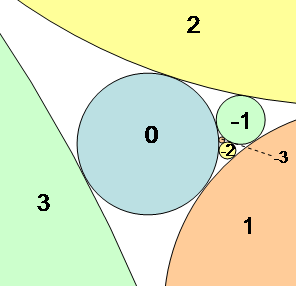
The circle marked "0" touches the three larger ones (numbers 1, 2, 3) and the three smaller ones (-1, -2, -3). And the sequence extends to infinity in both directions: ever-larger and ever-smaller circles, radii in a Golden Ratio. Each kisses the three before and the three after it, in a dizzying spiral. Wow!
(cf Hobbes and Geometry (2008-03-04), Genius at Play (2018-11-04), Certain Uncertainty (2021-03-16), Geometric Folding Algorithms (2024-05-18), ...) - ^z - 2025-01-24
- Friday, January 24, 2025 at 08:18:24 (EST)
Oliver Burkeman is a thoughtful person who writes well. His 2021 book Four Thousand Weeks: Time Management for Mortals is a set of variations on themes he played in The Antidote (2012), and has many of the same problems. Aside from poetic quotes by classic thinkers, there are few glimmers amidst the prose. Zen-like twists are fun: embrace your insignificance, give up the illusion of control, be a better procrastinator, etc. Live mindfully within a human lifespan, the "Four Thousand Weeks" of the title.
Further details, alas, are sketchy. Best, perhaps, are hints in the summary sections near the end of the book. Burkeman's "Five Questions" in the final chapter, for instance:
The Appendix "Ten Tools for Embracing Your Finitude" tries to be more specific, but sadly stumbles into platitudes, practical impossibilities, or trivialities:
OK ... and then?
(cf The Antidote (2013-06-28), Stand in the Shed (2055-01-04), Celebrate Healthy Habits (2025-01-07), ...) - ^z - 2025-01-23
- Thursday, January 23, 2025 at 10:27:01 (EST)
Jon Young's "What the Robin Knows: How Birds Reveal the Secrets of the Natural World" is actually a book about awareness, via the metaphor of ornithology. Its final paragraph summarizes the mindfulness-mission:
Part of that is to move, as the author says, with "awareness, connection, empathy, and respect" — outdoors in the presence of animals, and at every other moment in life. When discussing the senses and how to sharpen them, for instance, Jon Young offers beautiful metaphors to hold in the heart. From Chapter 4 ("The Sit Spot"):
When we train ourselves to listen to the birds with every synapse of our brains (or so it may seem), when we "lose our mind" and "come to our senses" in the fullest possible way, the chattering, texting, e-mailing, twittering mind will eventually quiet down and almost silence itself. This is a sacred and connected silence, and within this zone we can choose to turn on the conscious thoughts or leave them off. It's like a deep, still pond reflecting the stars of the night sky. I believe this is the baseline for human consciousness, and I'm convinced that the birds are the best mentors in the natural world for bringing us to it.
Yes, and ...
(cf Twitchers and Foamers (2013-12-15), Gentleness, Sensitivity, Compassion (2014-03-09), Taiji and Self Awareness (2014-04-15), Slow Birding (2022-12-22), Birding, Zen, and BirdCast (2023-04-19), ...) - ^z - 2025-01-20
- Monday, January 20, 2025 at 08:18:48 (EST)
Great Life Wisdom in chapter 2 of the delightful 1970 computer science textbook Numerical Methods that Work by Forman S Acton:
The ideas of computational strategy One of the more persistent messages of this book is an exhortation to suit the tool to the task. This exhortation, in turn, demands that both the tools and the task be understood. The essential shape of the problem to be solved must be discovered and then used as the driving force for the solution strategy. An elegant algorithm applied to the wrong problem is not apt to produce much enlightenment. Nor are large numbers of random trials to be justified simply because they are relatively easy. Seeking needles in haystacks, even with an electronic computer, is time consuming. It behooves the problem analyst to seek carefully for the important characteristics of his problem and then to pick a strategy that is appropriate. This art is difficult, for equations are often not what they at first appear nor are our numerical tools even close to universally applicable. A method that can find the isolated root of a cotangent-like curve may fail spectacularly when used on a polynomial with a triple root and a few bumps ...
... ditto for any other challenge in the World, eh?!
(cf Book Cover Judgment (2002-04-21), ...) - ^z - 2025-01-19
Suit the Tool
to the Task
- Sunday, January 19, 2025 at 08:06:26 (EST)
| "... life always provides reasons not to die, if we listen hard enough. Those reasons can stem from the past—the people who raised us, maybe, or friends or lovers—or from the future—the possibilities we would be switching off. ..." (from the chapter "A beautiful view") |
Matt Haig's Reasons to Stay Alive is an intensely personal, immensely important little book. It's a view-from-inside description of his depression and how it came, went, and returned – repeatedly. Especially insightful are some of his lists, such as this one from the chapter "How to be there for someone with depression or anxiety":
3. Be gentle with yourself. Work less. Sleep more. 10. Wherever you are, at any moment, try and find something beautiful. A face, a line out of a poem, the clouds out of a window, some graffiti, a wind farm. Beauty cleans the mind. 14. Look at the sky. Remind yourself of the cosmos. Seek vastness at every opportunity, in order to see the smallness of yourself. 15. Be kind. 22. Live. Love. Let go. The three Ls. 25. Read a book without thinking about finishing it. Just read it. Enjoy every word, sentence, and paragraph. Don't wish for it to end, or for it to never end. 28. If someone loves you, let them. Believe in that love. Live for them, even when you feel there is no point. 32. Remember that there is nothing weird about you. You are just a human, and everything you do and feel is a natural thing, because we are natural animals. You are nature. You are a hominid ape. You are in the world and the world is in you. Everything connects. 39. Just when you feel you have no time to relax, know that this is the moment you most need to make time to relax. 40. Be brave. Be strong. Breathe, and keep going. You will thank yourself later.
Haig talks about panic, despair, smoking, drinking, anxiety, and many other facets of his depression. He tells what sometimes helped him – literature, travel, medication, and above all friendship. The chapter "Running" describes his experience with exercise and concludes:
Near the end of this tiny book Haig offers "How to live (forty pieces of advice I feel to be helpful but which I don't always follow)". A small subset-sample:
It helped, sometimes. Not always. It wasn't foolproof. I wasn't Zeus. There were no magic thunderbolts at my disposal. But it is nice to build up, over the years, things that you know do—on occasion—work. Weapons for the war that subsides but that can always ignite again. And so writing, reading, talking, traveling, yoga, meditation, and running were some of mine.
So important, so good. Awesome advice for those in depression — and for everyone else.
And it all boils down to love ...
(cf Therapies for Depression (2015-10-04), Another Look at Depression (2018-08-12), Michael Gerson sermon (2022-11-19) Midnight Library (2025-01-11), ...) - ^z - 2025-01-18
- Saturday, January 18, 2025 at 07:33:36 (EST)
A Walk in the Park by Kevin Fedarko (2024) is subtitled "The True Story of a Spectacular Misadventure in the Grand Canyon". It describes a hike of ~800 miles along the cliffs of the Grand Canyon National Park as performed by the author, his friend Pete McBride, and various helpful experts.
Fedarko's prose is generally good, though sometimes a bit turgid when describing the awesome scenery, sometimes excessively first-person, sometimes distractingly preachy, but overall fast-flowing and enjoyable. The real problems with the book are the unfortunate absence of decent maps keyed to the journey, the lack of an index, the failure to include a timeline, and the generally poor quality of the illustrations. Perhaps some future edition can remedy those issues!
(cf Eastern Yosemite Mountains (2006-06-02), ...) - ^z - 2025-01-13
- Monday, January 13, 2025 at 17:26:39 (EST)
Matt Haig's novel The Midnight Library is a sweet allegory about depression and suicide – or perhaps, about choosing to live and discovering happiness, meaning, and love. The protagonist tries to kill herself. She appears in a limbo/bardo place, represented by an infinite "library", full of many-world quantum-mechanical "books", each a biography of an alternate life. She samples several, and eventually discovers ... well, that's the plot!
Midnight Library isn't terribly deep conceptually, the prose isn't terribly poetic, the characters aren't terribly surprising — and that's OK. The thoughts it offers are wise and kind. Good enough!
(cf Many Worlds Demystified (1999-10-24), Worst Zen Student That Ever Was (2012-03-10), Oblique Life (2013-08-14), Therapies for Depression (2015-10-04), Another Look at Depression (2018-08-12), Depression as a Gift (2023-01-16), ...) - ^z - 2025-01-11
- Saturday, January 11, 2025 at 08:29:18 (EST)
David Brooks in "The Character-Building Tool Kit" summarizes University of Pennsylvania psychologist Angela Duckworth's list of key strengths:
Brooks talks about inspirational teachers, such as "... a physics professor who doesn’t teach only physics but also the scientific way of life — how to lead a life devoted to wonder, curiosity, intellectual rigor and exploration." He describes facets of character-building at some special schools:
... They have a sense of moral mission, that who you become is more important than what career track you pursue. ... They have a clear goal and everybody knows their role in achieving it. They have rituals to mark transitions. They have retreats and group travel so that people can see one another before the makeup goes on. They provide opportunities for struggle and growth. They often have sacred symbols and initiation rituals so that everybody knows they belong. ...
... and key skills:
Brooks finishes with discussion of rôle models, moral traditions, great books, self-confrontation, and community service. Good thoughts on being good!
(cf What Moderates Believe (2017-08-26), Disagreement under Disagreement (2020-12-02), Most People Seek to Be Good (2023-06-19), David Brooks on Being Human (2023-10-21), How to Stay Sane in Brutalizing Times (2023-11-05), Middle Manager Magic (2024-04-12), ...) - ^z - 2025-01-10
- Friday, January 10, 2025 at 10:57:41 (EST)
Douglas Hofstadter's responded to Peter Coy's question in the NYT column "What 15 Very Different People Hope to See in 2025":
I hope somehow to regain some measure of hope in this, the most ominous-seeming year that I have yet faced. Over this past year, and especially these last few months, I have lost much of my once-strong faith in humanity, but I hope, somehow, to regain at least a little bit of it in 2025. How, I certainly don’t know, but hope springs eternal.
(cf Indra's Net (2009-06-21), ...) - ^z - 2025-01-10
- Friday, January 10, 2025 at 08:56:18 (EST)
"How meditation deconstructs your mind" by Oshan Jarow in Vox is a fascinating overview of modern neuroscience and psychology research as applied to mindfulness practice. Key points:
Jarow describes these neuroscientific theories as "stories" — good stories, that suggest new testable hypotheses. He concludes by quoting Shamil Chandaria of Oxford University's Centre for Eudaimonia and Human Flourishing:
“Ultimately…all these stories are pointing to the moon. But [contemplative traditions] were pointing with their fingers. Now, we have laser pointers.” And as science progresses, “we’ll be able to work with what we’re finding out about the brain,” he added. “It’s actually about making progress, and by progress, I mean more useful stories.”
And maybe it's just bayesian knobs, all the way down?!
(cf Finding the Quiet (2009-12-05), Mantra - Beliefs Are Knobs, Not Switches (2017-07-03), Being You (2023-11-01), Little Book of Being (2024-12-03), ...) - ^z - 2025-01-09
- Thursday, January 09, 2025 at 16:44:36 (EST)
Turn the "New Year's Resolutions" gambit on its head! Lori Leibovich's NYT essay "How to Future-Proof Your Happiness in the New Year" suggests several approaches, including thoughts from Oliver Burkeman:
... resolutions can sometimes make people feel worse, not better. We often expect massive changes done perfectly from the outset, he explained. So whatever you hope to do in the new year, let yourself start off poorly. “Ten minutes spent very badly jogging,” he said, is “just infinitely more valuable than all the most amazing plans to do it perfectly.”
... and from Chris Bennett, who recommends re Resolutions:
... Don’t do them. Instead, double down on the healthy habits you already have “and then celebrate them,” he said.
Maybe you read before bed each night or avoid grabbing your phone first thing in the morning. Try not to take these habits for granted, he said: “We do really great, awesome things that we would make a resolution to do if we weren’t already doing them.”
Excellent inversion of the obvious!
(cf The Antidote (2013-06-28), Stand in the Shed (2025-01-04), ...) - ^z - 2025-01-07
- Tuesday, January 07, 2025 at 18:56:47 (EST)
| "Stop taking it so seriously. We are not changing the world. Everyone needs to get over themselves. We’re trying our hardest. We’re doing our best. Let’s not think about it much more than that. We’re all in entertainment, ladies and gentlemen — let’s entertain." |
... life-wisdom from retired Aussie Rules Football star Tony Armstrong in The Guardian interview "Feral cat tasted like the most delicious rotisserie chicken I’ve ever had" by Sian Cain.
(cf Sparky and Sandy (2002-07-24), Light Mind (2002-08-22), Unselfing (2009-01-14), Unselfing Again (2009-11-01), ...) - ^z - 2025-01-06
- Monday, January 06, 2025 at 09:44:45 (EST)
In The Guardian, helpful advice from Oliver Burkeman via the podcast "How to have a perfectly imperfect 2025" by interviewer Helen Pidd. From the summary:
... when you have a huge task you are putting off – such as clearing out your shed [– the] most important thing to do is take a tiny first step. Even imagining yourself doing it, or just going to stand in the messy shed is enough.
It’s a simple idea with many applications. For instance, if you have a generous impulse, act on it immediately, rather than throwing yourself into a grand gesture which you may never finish. And above all, remember that if you stop trying to be perfect and control every aspect of your life you might find more things to delight in.
... and there's a chance that the "tiny first step" might be far more important than anything else you do later!
(cf One Small Step (2010-06-23), Dan Ariely Lecture (2011-02-10), Shikake (2012-12-18), Thousand-Year View (2014-06-10), toki sona - pona lili li pona sewi (2024-08-30), ...) - ^z - 2025-01-04
- Saturday, January 04, 2025 at 06:53:23 (EST)
Just remember:
How likely is it that the enemy will attack at dawn, that the next card is an ace, that you will catch the flu, or that you will get married next year? To answer any probabilistic question, "Bayes Rule" says to start with your best guess of the chance for each possible result, then adjust those guesses based on information as it arrives. If a new observation is surprising, make a big adjustment; if it's ho-hum just-as-expected, make little or no adjustment.
Note the two key components:
For simple well-defined cases, like rolling dice or winning a lottery, precise baseline odds and the size of updates can be computed with a little math. Complex real-world situations, in contrast, demand relevant experience and good judgment — but the same principles apply. For example, to estimate your chance of being in a traffic accident tomorrow:
And most important: continue to adjust as new evidence arrives. If your team is evenly-matched with their opponent before the big game, the odds of winning are about 50%. If your team falls behind in the final minutes, the odds become worse. If a nice slice of cake awaits you in the refrigerator at home, the likelihood of an enjoyable dessert is high. But when you arrive if you find unexpected visitors and a party underway, chances fall for finding that food uneaten.
And finally: don't be too sure! Common cognitive fallacies involve anchoring on old beliefs, under-adjusting for new evidence, overlooking alternative outcomes, and seeking evidence to confirm rather than refute judgments.
| Stay open to surprise! |
(cf Statistics - A Bayesian Perspective (2010-08-13), Introduction to Bayesian Statistics (2010-11-20), Mantra - Beliefs Are Knobs, Not Switches (2017-07-03), Think Better - Three Keys (2019-06-05), ...) - ^z - 2025-01-01
- Wednesday, January 01, 2025 at 07:03:04 (EST)
Just a bag of bones
And blood and filth
Just an animal
Cowering in fear
Just a speck of cosmic dust
Orbiting an average star
Just a matrix of biochemical pathways
Feedback loops and coupled equations
Just a giant robot clumsily following instructions
From tiny genes demanding it build copies of itself
Just a whirl of thoughts and hopes and dreams
Clashing against the constraints of reality
Just a long list of laws with penalties for
Disobedience and rewards for submission
Just symbol-manipulators running
On unreliable hardware
Just a soul trapped inside
A cracked shell
Just all of these
And much more
Just love
(cf Light of Evolution (2006-04-24), What We Know (2006-08-15), Present in Every Moment (2019-11-15), You Are a Poem (2020-02-10), ...) - ^z - 2024-12-31
- Tuesday, December 31, 2024 at 08:01:55 (EST)
Could there be a language
In which poetry is the only way
To speak?
Is there a tongue where metaphor
Drives a cart which a "literal" equine
Can never get ahead of?
Where similies, like water,
Wear away the weary stones
Of words?
What airy thoughts might such a speech support,
Without a foundation of reference to referents?
Could it lift itself by bootstraps, self-sufficient?
Or would it slump into a
Quasi-structureless
Stack of questions?
(see "Lexicalization" in the Toki Pona wiki, and here cf Mines of Metaphor (1999-09-28), Writing vs Good Writing (2018-01-21), Speak, Poetry (2018-03-23), ...) - ^z - 2024-12-29
- Sunday, December 29, 2024 at 08:00:46 (EST)
Rebecca Barry's heartfelt NYT essay "Alzheimer’s Can Be a World of Endless Second Chances" celebrates her Father's mind just-as-it-is — descending into dementia, and yet full of love and surprises. Ms Barry's gratitude-list includes:
... and even more magical:
Because he lives in a world that isn’t governed by time, entering the house is like moving into a sacred realm where anything can happen and all that matters is the person in front of you. I love this place. Nothing has to be factually true. The past can be erased or reinvented at any time. There is a beautiful flow when you let go of caring about what he remembers or arguing about what’s real. When someone is traveling to a different land, why not join him?
I also love the freedom in talking to someone knowing he’ll forget most of what you say. There are endless second chances.
... and there's Ms Barry's beautiful set of questions she asks herself:
... And sometimes I wonder, what is my memory keeping from me? If I didn’t remember past hurts and grudges, how much lighter and more forgiving would I be? Would we all be nicer to one another if we remembered less? Love people we otherwise don’t? Love people we do even better?
... and her description of a key facet of her father's mind:
| "When the brain isn’t working as hard, it doesn’t block the heart connection." |
... so wonderful an aspiration, for all minds, at all times of life!
(cf Nonattachment to I (2012-01-15), Heartfulness and Mindfulness (2014-12-15), Fear of Failing (2015-07-08), Fraying at the Edges (2016-05-04), Mantra - Mind Your Heart (2024-08-22), ...) - ^z - 2024-12-26
- Thursday, December 26, 2024 at 08:09:13 (EST)
James McBride's autobiography The Color of Water is subtitled "A Black Man's Tribute to His White Mother". It gets its name from his mother's answer when, as a young child, McBride asked her what color God was. "God is the color of water. Water doesn't have a color." was her reply. McBride alternates chapters based on interviews with his mother — Ruth Shilsky McBride Jordan (1921-2010), who grew up Jewish, married Black men, became a devout Christian, and raised a dozen children — with chapters focusing on his own challenges while growing up. A sample from Chapter 22 ("A Jew Discovered"):
That night I slept in a motel just down the road from the McDonald's, and at about four in the morning I sat straight up. Something just drew me awake. I tossed and turned for an hour, then got dressed and went outside, walking down the road toward the nearby wharf. As I walked along the wharf and looked over the Nansemond River, which was colored an odd purple by the light of the moon, I said to myself, "What am I doing here? This place is so lonely. I gotta get out of here." It suddenly occurred to me that my grandmother had walked around here and gazed upon this water many times, and the loneliness and agony that Hudis Shilsky felt as a Jew in this lonely southern town—far from her mother and sisters in New York, unable to speak English, a disabled Polish immigrant whose husband had no love for her and whose dreams of seeing her children grow up in America vanished as her life drained out of her at the age of forty-six—suddenly rose up in my blood and washed over me in waves. A penetrating loneliness covered me, lay on me so heavily I had to sit down and cover my face. I had no tears to shed. They were done long ago, but a new pain and a new awareness were born inside me. The uncertainty that lived inside me began to dissipate; the ache that the little boy who stared in the mirror felt was gone. My own humanity was awakened, rising up to greet me with a handshake as I watched the first glimmers of sunlight peck over the horizon. There's such a big difference between being dead and alive, I told myself, and the greatest gift that anyone can give anyone else is life. And the greatest sin a person can do to another is to take away that life. Next to that, all the rules and religions in the world are secondary; mere words and beliefs that people choose to believe and kill and hate by. My life won't be lived that way, and neither, I hope, will my children's. I left for New York happy in the knowledge that my grandmother had not suffered and died for nothing.
Thoughtful, engaging, well-written ... and exploring still-complex issues of religion, race, society ...
(cf Interracial Intimacies (2003-02-24), Racial Relationships (2004-01-10), An Hour before Daylight (2004-05-25), Interracial Checkmate (2004-07-20), Race and Love (2004-08-06), ...) - ^z - 2024-12-25
- Wednesday, December 25, 2024 at 20:33:50 (EST)
Sweet thoughts in "Why ‘A Christmas Carol’ Endures", a New York Times essay by Roger Rosenblatt – concluding:
We are all capable of narrow-mindedness, of selfishness and greed. We are all concerned for our own material enrichment. But so too are we capable of fantastic generosity and selflessness. Dickens understood this, and it was in demonstrating the benefits of raising our moral consciousness that the quiet genius of “A Christmas Carol” most shines through. ... Nothing satisfies a sinful reader (that is, everyone) as much as a tale in which we are given a chance to vicariously work off our sins — particularly when redemption comes fairly easily, after the scare of a single night and three brief sermons. We look at the repentant Ebenezer and think: C’est moi! From now on, I shall live differently, more honorably. I shall reform. Entire religions are based on what Scrooge experiences and on what he vows. This is what Dickens sought to teach us nearly 200 years ago, and it is why his message resonates all these years later. “A Christmas Carol” has endured both because it is a great story and because it offers us an eternal example of the joy that is possible when we turn toward our better angels. We will take to “A Christmas Carol” in this season, as have the millions before us, but with a special thump of the heart. Because the story believes in our better, more generous inner selves. And the actions of those inner selves are the only way we will be truly blessed. Every one.
(cf My Business (1999-05-30), Christmas Faith (2000-12-23), Yes, Virginia (2004-12-26), ...) - ^z - 2024-12-25
- Wednesday, December 25, 2024 at 09:46:14 (EST)
From the New York Times "Your Favorite Things" news note of 21 Dec 2024, three selections (lightly edited for format):
(cf Thanks For (2001-11-22), Gratefulation and Gratituding (2021-11-11), ...) - ^z - 2024-12-21
- Saturday, December 21, 2024 at 07:39:10 (EST)
Bits from the transcript of a conversation between NY Times columnist David French (religious, evangelical Christian) and Jonathan Rauch (self-described as "gay and atheistic and Jewish") titled "What if Our Democracy Can’t Survive Without Christianity?". Rauch has a forthcoming book (Cross Purposes: Christianity’s Broken Bargain With Democracy) and the dialogue relates to some of its key points. In Rauch's judgment:
... the three fundamentals of Christianity map very well onto the three fundamentals of Madisonian liberalism. And one of those is don’t be afraid. No. 2 is be like Jesus. Imitate Jesus. And No. 3 is forgive each other. And those things are very much like how you run a constitutional republic. You can’t be afraid of losing all the time. Sometimes you’ve got to let the other team win. You have to trust in the system. You have to believe in traits like the basic dignity and equality and humanity of everyone, even the people you oppose. And you can’t be so judgmental that you think if you lose the next election everything is over, and that bad people win and you’ve somehow got to drive them out of the country."
It turns out that Christianity is a load-bearing wall in democracy, and the founders told us that. They didn’t specify that you have to be a Christian, per se, but they said that our liberal, secular Constitution, it’s great, as far as it goes, but it relies on virtues like truthfulness and lawfulness and the equal dignity of every individual. And they understood that those have to come from an outside source. The Constitution won’t furnish them. And the source that they relied on principally was religion to teach those things and to build and transmit those values. And it turns out that for most of our history, Christianity has been pretty good at that. I mean, lots of exceptions, of course. But what I didn’t realize 20 years ago is how right they were. And that once Christianity begins caving in, people begin looking other places for their sources of values. They go to “wokeness” or QAnon or MAGA. And those turn out to be not the kinds of values that you can use to underpin a democracy. And that’s the situation that we seem increasingly stuck in.
and
Rauch contends that Christianity fails if it becomes "thin" (a secularized consumer good) or "sharp" ("at war with the culture around it") — and that, to be a support for democracy, Christianity needs to be "thick" (committed to the teachings of Jesus).
Rauch concludes:
... I have learned that there are teachings at the core of Christianity which are beautiful and true. You don’t have to believe in Jesus to believe them. You can believe in James Madison to believe them because they’re similar, and that’s not coincidental. And I think it can only do good and not harm to the country and to Christian witness, if Christians can do the work of rediscovering and elevating those elements of the Christian faith which uphold our democracy and which uphold the teachings of Christ. I can’t see that any possible harm would result from that. And so what I come down to is addressing my Christian fellow citizens and saying, why not give Jesus a try?
(cf Foam on the Ocean (2000-07-13), Christmas Faith (2000-12-23), Passage to India - God Is Love (2017-09-23), ...) - ^z - 2024-12-21
- Saturday, December 21, 2024 at 07:03:26 (EST)
| More Meta Less Clinging |
That's Diana Winston's 2019 The Little Book of Being: Practices and Guidance for Uncovering Your Natural Awareness. It's both disorganized and brilliant, as it explores an alternative to "classical mindfulness", the structured practice of focused attention. Winston says in the Introduction: "There are multiple ways to be aware: from the effortful to the effortless, from the narrowly focused to the wide open and spacious, from awareness of objects to objectless awareness of awareness." What a lovely summary of the entire enterprise!
The journey to Natural Awareness that Winston describes is gentle, meandering, rather first-person, and filled with delights. A few signposts along the way, starting in Chapter 6, "The Spectrum of Awareness Practices":
At one end of the spectrum is what we might call focused awareness practice. When we are practicing focused awareness, we're making an effort and focusing narrowly on an object—often our breath. When our attention wanders, we notice it has wandered and then return our attention to our breath (or other object of focus). Focused awareness practice is the classical mindfulness meditation practice most people begin with, and it is useful for training unruly minds. It helps us develop stabilization, concentration, and clarity of mind. ... Next along the spectrum is what we might call flexible awareness practice, which is also taught within classical mindfulness meditation When we are practicing flexible awareness, our awareness has a wider field, rather than being narrowed to only one central focus (like our breath). Sometimes we flexibly move our attention to investigate other objects of awareness that pull us away from our main focus (such as a sound, a sensation, or an emotion) and then return to our main focus after a while. Sometimes our attention may appear to jump around from object to object, and we rarely return to a main focus. Effort is variable, attention is both broad and narrow, and we still focus on objects. ... On the far end of the spectrum is natural awareness practice, which is not commonly included in classical mindfulness meditation. Natural awareness practice is usually effortless and objectless, emphasizing awareness of awareness. With natural awareness practice, we don't have to try so hard. Our mind tends to rest in a place of ease, and awareness seems to happen on its own. Typically, attention is broad, and it doesn't focus on objects ...
While meditating with open eyes, shift into mindful seeing, softly gazing at what is in front of you and/or having an awareness of the periphery. Once you feel stably aware of the visual field, for fun, see if you can notice the space between the objects rather than the objects themselves. Don't focus on what your eyes are naturally drawn to, but instead on the space surrounding those things. Soften, relax, and connect with the space. What happens as you do this? Trust what emerges, letting whatever unfolds unfold. Relax and marinate in your discoveries. In daily life you might try this glimpse practice outside under a night sky. Can you notice the space in between the billions of stars?
When people access natural awareness, they typically experience natural awareness as only right in front of them. There is nothing wrong with this experience per se, but it is incomplete. Natural awareness is actually directionless. It can be externally experienced in a forward-facing direction, but it can also be experienced in all directions—behind, above and below us. Additionally, we can experience it internally, when we include our bodies in our natural awareness. All of the qualities we might notice in forward, externl natural awareness can be present inside our very body. We might feel spacious, soft, warm, relaxed, and any of the other facets of the diamond I talked about in chapter 11. Any of these qualities could be sensed quite strongly inside our bodies. Then we can make another step and sense natural awareness externally and internally simultaneously. It is important for the awareness to become sensed internally, or embodied, because this shift allows us to function from the natural awareness. Natural awareness starts to feel more like an aspect of our physical body, not just an aspect of our mind. We can lead our lives from a place of embodied natural awareness, in which we are not merely a head with a body dangling from it.
Once many years ago, while practicing with one of my teachers, I asked a question: "How do you make natural awareness increase?" His response was, "Natural awareness doesn't increase. Clinging lessens." ...
Every morning when I meditate, I say a short meditative prayer to begin my practice. It is of Buddhist origin, taken from Shantideva, an eighth-century Buddhist monk and scholar. It goes like this:
After Chapter 32, in a Glimpse Practice titled "The Space Between Things":
In Chapter 35, "Embodiment":
Near the end of Chapter 38, "Caught or Free?":
In Chapter 45, "Intend Compassion":
In Chapter 47, "Don't Do It Alone":
It takes just one other person to create a community. ... You can discuss your practice, share questions, and explore how to implement natural awareness practices in daily life all by phone, video chat, or text.
All good — especially the emphasis on being gentle and loving-kind toward oneself!
(cf Wherever You Go, There You Are (2008-10-26), Being with Your Breath (2010-02-20), Fully Present (2011-02-14), Find the Beauty (2011-04-03), Bringing Back a Wandering Attention (2013-02-13), Mindfulness for Beginners (2013-07-18), Beginning Mindfulness (2013-09-22), Metacognitive Awareness (2018-05-19), Mantra - Be Meta, Be Open, Be Love (2018-11-11), ...) - ^z - 2024-12-03
- Tuesday, December 03, 2024 at 22:26:20 (EST)
Brad Stulberg writes in his NYT op-ed essay "How to Keep Going Amid the Chaos" about the concept of "tragic optimism", defined by Viktor Frankl as arising from "the three tragedies" of life:
... The first tragedy is pain, because we are made of flesh and bone. The second is guilt, because we have the freedom to make choices and thus feel responsible when things don’t go our way. The third is loss, because we must face the reality that everything we cherish is impermanent, including our own lives. Tragic optimism means acknowledging, accepting and even expecting that life will contain hardship and hurt, then doing everything we can to move forward with a positive attitude anyway. It recognizes that one cannot be happy by trying to be happy all the time, or worse yet, assuming we ought to be. Rather, tragic optimism holds space for the full range of human experience and emotion, giving us permission to feel happiness and sadness, hope and fear, loss and possibility — sometimes in the same day, and even in the same hour.
Tragic optimism does not encourage actively seeking out or romanticizing suffering. Not everything has to be meaningful; sometimes things just suck. Rather, tragic optimism realizes the inevitability of suffering but also that we generally have at least some say in how we face it. Difficult moments, both personal and collective, often lead to extreme behaviors: what’s now known as toxic positivity on the one hand — burying our heads in the sand and deluding ourselves that everything is great — or excessive pessimism and despair on the other. Both absolve us of doing anything about the situation. Excessive optimism and delusion, at root, deny that anything is wrong; and if nothing is wrong, there is nothing to worry about and nothing to change. Extreme pessimism and despair are so grim they essentially say that any action would be pointless. Between these two poles exists a third way: committing to wise hope and wise action. Wise hope and wise action ask us to accept a situation and see it clearly for what it is, and then muster the strength, courage and resolve to focus on what we can control. We remind ourselves that we have faced challenges before. We continue because to stand still is not an option. Recognizing that we maintain agency fuels hope, and maintaining hope reminds us that we have agency. Resilience comes down to a few core factors: leaning into community, being kind to yourself, finding small routines to support your mental health, allowing yourself to feel sadness and loss and yet maintain hope at the same time. It requires a commitment to taking productive action.
Stulberg's concluding advice:
So important to aspire for, so challenging to achieve ...
(cf Bennett on Stoicism (1999-04-29), Search for Meaning (2005-08-27), David Brooks on Being Human (2023-10-21), ...) - ^z - 2024-11-30
- Saturday, November 30, 2024 at 11:20:11 (EST)
Gentle, beautiful, and full of loving-kindness: John Green's 2012 young adult novel The Fault in Our Stars explores death, life, the universe, and much more. Its protagonist is Hazel Grace Lancaster, a 16-year-old girl living with and dying of cancer. Most of its central characters are young people with cancer, or family members thereof. Its plot is a quest and a love story, with deep philosophy at its core. A few striking snippets, starting in Chapter 1 at a support-group meeting:
Isaac and I communicated almost exclusively through sighs. Each time someone discussed anticancer diets or snorting ground-up shark fin or whatever, he'd glance over at me and sigh ever so slightly. I'd shake my head microscopically and exhale in response.
"Not your fault, Hazel Grace. We're all just side effects, right?" "'Barnacles on the container ship of consciousness,'" I said, quoting AIA. "Okay," he said. I gotta go to sleep. It's almost one." "Okay," I said. "Okay," he said. I giggled and said, "Okay." And then the line was quiet but not dead. I almost felt like he was there in my room with me, but in a way it was better, like I was not in my room and he was not in his, but instead we were together in some invisible and tenuous third space that could only be visited on the phone. "Okay," he said after forever. "Maybe okay will be our always." "Okay," I said. It was Augustus who finally hung up.
"That's too bad. I am so in the mood for poetry. Do you have anything memorized?" "'Let us go then, you and I,'" I started nervously, "'When the evening is spread out against the sky / Like a patient etherized upon a table.'" "Slower," he said. I felt bashful, like I had when I'd first told him of An Imperial Affliction. "Um, okay. Okay. 'Let us go, through certain half-deserted streets, / The muttering retreats / Of restless nights in one-night cheap hotels / And sawdust restaurants with oyster-shells: / Streets that follow like a tedious argument / Of insidious intent / To lead you to an overwhelming question . . . / Oh, do not ask, "What is it?" / Let us go and make our visit.'" "I'm in love with you," he said quietly. "Augustus," I said. "I am," he said. He was staring at me, and I could see the corners of his eyes crinkling. "I'm in love with you, and I'm not in the business of denying myself the simple pleasure of saying true things. I'm in love with you, and I know that love Is just a shout into the void, and that oblivion is inevitable, and that we're all doomed and that there will come a day when all our labor has been returned to dust, and I know the sun will swallow the only earth we'll ever have, and I am in love with you." "Augustus," I said again, not knowing what else to say. It felt like everything was rising up in me, like I was drowning in this weirdly painful joy, but I couldn't say it back. I couldn't say anything back. I just looked at him and let him look at me until he nodded, lips pursed, and turned away, placing the side of his head against the window.
"Also, it was a bit hopeless," he said. "A bit defeatist." "If by defeatist you mean honest, then I agree." "I don't think defeatism is honest," Dad answered. "I refuse to accept that." "So everything happens for a reason and we'll all go live in the clouds and play harps and live in mansions?" Dad smiled. He put a big arm around me and pulled me to him, kissing the side of my head. "I don't know what I believe, Hazel. I thought being an adult meant knowing what you believe, but that has not been my experience." "Yeah," I said. "Okay." He told me again that he was sorry about Gus, and then we went back to watching the show, and the people picked a house, and Dad still had his arm around me, and I was kinda starting to fall asleep, but I didn't want to go to bed, and then Dad said, "You know what I believe? I remember in college I was taking this math class, this really great math class taught by this tiny old woman. She was talking about fast Fourier transforms and she stopped midsentence and said, 'Sometimes it seems the universe wants to be noticed.' "That's what I believe. I believe the universe wants to be noticed. I think the universe is improbably biased toward consciousness, that it rewards intelligence in part because the universe enjoys its elegance being observed. And who am I, living in the middle of history, to tell the universe that it–or my observation of it–is temporary?" "You are fairly smart," I said after a while. "You are fairly good at compliments," he answered.
I thought about it. My old stock answer was that I wanted to stay alive for my parents, because they would be all gutted and childless in the wake of me, and that was still true kind of, but that wasn't it, exactly. "I don't know." "In the hopes that you'll get better?" "No," I said. "No, it's not that. I really don't know. Isaac?" I asked. I was tired of talking. Isaac started talking about true love. I couldn't tell them what I was thinking because it seemed cheesy to me, but I was thinking about the universe wanting to be noticed, and how I had to notice it as best I could. I felt that I owed a debt to the universe that only my attention could repay, and also that I owed a debt to everybody who didn't get to be a person anymore and everyone who hadn't gotten to be a person yet. What my dad had told me, basically.
... and in Chapter 5, where Hazel and Augustus invent a new codeword to share, a secret verbal hug, during a late-night telephone conversation:
... and in Chapter 10, sitting side-by-side during a long airplane trip:
... and in Chapter 14, when Heather and her father are talking together about a book and about life:
... and near the end, in Chapter 24, as Heather responds to a question about why she shouldn't wish for her own death:
... and much, much more.
(cf Search for Meaning (2005-08-27), Easter Morning Musings with a Friend (2008-03-24), Never Forgotten (2024-08-16), An Abundance of Katherines (2024-11-12), ...) - ^z - 2024-11-21
- Thursday, November 21, 2024 at 11:21:45 (EST)
"Against Panic: A Survival Kit" by New York Times columnist Margaret Renkl paints a beautiful portrait of Nature and its power to preserve, protect, and defend the spirit, especially in times of turmoil. Best brief bits perhaps include:
It's all about staying strong, long-term, to help repair the World ...
(cf Vastness, Equanimity, Selflessness (2015-06-04), Joko on Joy (2015-09-03), Tikkun Olam (2019-12-11), Most Beautiful Day (2023-07-01), Love for Imperfect Things (2024-02-12), ...) - ^z - 2024-11-13
- Wednesday, November 13, 2024 at 07:40:17 (EST)
By John Green, An Abundance of Katherines (2006) is a delightful young adult novel – beautifully written, hilarious in places – about various misadventures of Colin, an anagrammatic teenage prodigy (but maybe not genius) and his friends. There's a wee bit of math (that could have been done better) and a truckload of fun, all served up with a splash of thoughtfulness and Meaning-of-Life philosophy. From the epilogue:
... And he found himself thinking that maybe stories don't just make us matter to each other—maybe they're also the only way to the infinite mattering he'd been after for so long.
And Colin thought: Because like say I tell someone about my feral hog hunt. Even if it's a dumb story, telling it changes other people just the slightest little bit, just as telling the story changes me. An infinitesimal change. And that infinitesimal change ripples outward—ever smaller but everlasting. I will get forgotten, but the stories will last. And so we all matter—maybe less than a lot, but always more than none.
... beautiful, hopeful, true.
... pona lukin, pona tenpo kama, lon
(in Wikipedia with many spoilers: An Abundance of Katherines — and cf Worth the Cost (2004-02-03), Easter Morning Musings with a Friend (2008-03-24), The Meaning of Life (2008-07-24), Lines of a Story (2017-11-28), Never Forgotten (2024-08-16), ...) - ^z - 2024-11-12
- Tuesday, November 12, 2024 at 08:06:05 (EST)
andI think people need something just to concentrate on. There's something about — you know, when your life is sort of falling apart — you need to create a purpose in it for yourself, and if that purpose is quite small it doesn't matter, it's important — something tangible, something they can say, "Well, that's mine, I'm going to do that today!" — and it's it's worth getting up for.
andPeople say, "Oh, how beautiful", and you know it's not, you know there's lots of mistakes in it!
andLooking at the therapeutic benefits of knitting, it's not just the making, it's also the giving of a gift, giving away. The idea is that people just come together. The whole thing is, there's no right or wrong. It doesn't matter if you make a mistake. You make your bird, and you give it away, if you want to.
andMistakes can be undone. You can cover a mistake with a button or a crochet flower or something, so that the mistakes don't matter!
Oh, I've unraveled a lot over the years — well, knitting, and myself possibly! Would you like a coffee now, dear?
(New York Times gift-link and Youtube link — cf obituary of Mason Rankin, excerpt in McGs (2002-02-28), and Crochety Crochet (2011-03-14), ...) - ^z - 2024-11-10
- Sunday, November 10, 2024 at 07:26:06 (EST)
Much like the Canterbury Tales of Chaucer, in the District Court on 2024-11-08 a series of diverse stories unfold — of justice and mercy, process and compromise, sin and redemption. Judge Amy Bills presides and:
Bottom line: it's all about the third phase of the Social Process: after Rules (aka laws) are defined, and somebody is accused of Breaking the rules, then there is an open, fair, documented, auditable process to Interpret and Apply the rules. Fascinating!
(i'm there in case i'm needed to testify about events witnessed on 23 Sep 2024, when a mentally disturbed person took off their clothes and stood naked in front of several houses in the neighborhood, praying and chanting for souls that they felt were in need of help – as it turned out, the person entered a guilty plea and is getting treatment; cf Opaque Justice (2002-01-29), For Great Justice (2002-12-01), Winter's Tale on Justice (2014-11-03), ...) - ^z - 2024-11-09
- Saturday, November 09, 2024 at 18:06:22 (EST)


| R.I.P. Frederic Jameson 1934-2024 |
(for a dense sample of Jameson's writing about detective novelist Raymond Chandler see "Real Qualities of the Microcosm: Raymond Chandler in Los Angeles, USA") - ^z - 2024-09-28
- Saturday, September 28, 2024 at 07:38:47 (EDT)
"Malcolm Gladwell Holds His Ideas Loosely. He Thinks You Should, Too.", an interview with Gladwell by Emma Goldberg, brilliantly puts its key point in the title. Other excellent comments along the way:
(see New York Times gift-link to the interview, and here cf Science vs Stamp Collecting (2000-06-20), Retrospective History (2003-03-07), ...) - ^z - 2024-09-26
- Thursday, September 26, 2024 at 10:54:25 (EDT)
"I Wanted to Crave Him, Not Have Him", a New York Times essay by Lei Wang, pirouettes around a wonderful Chinese word: zhiji, written zhī jǐ with tones, or 知己 in characters. It literally means "know yourself". Wang begins:
One of the most intimate relations in Chinese culture is known as the “zhiji” — the “know-self,” one who knows you like you know yourself. This is a connection outside of any social role, something beyond even best-friendship, like a platonic soul mate. The Chinese describe the feeling a know-self inspires as different from friendly, romantic or familial feelings: It is considered a fourth kind of feeling.
It is friendship with a certain spark, but not quite romance — the ideal spiritual relationship.
It's a "Modern Love" essay, and Wang goes on to tell her own know-self friend-forever story, plus confessional-commentary on other relationships. She shares delightful philosophical asides, e.g.: "What we call platonic now was actually the highest rung of Plato’s Ladder of Love, which ran from lowly love of the earthly to love of the celestial — love in its most spiritual form."
Bottom line in one word: invariable. Like the North Star (see Shakespeare's Sonnet 116) or the compass-point circle-center (see John Donne's Valediction: Forbidding Mourning). People who are always there, and always here, for each other. One.
(cf Mantra - We Are One (2017-04-18), Other Significant Others (2024-05-07), ...) - ^z - 2024-09-20
- Friday, September 20, 2024 at 13:46:34 (EDT)
"The Sentinel" by Casey Cep is a beautiful profile of Ron Walters, civil servant, head of the National Cemetery Administration. It's long, inspirational, kind, and thoughtful. A sample from near the end:
… “He would’ve made a great priest,” Rosemary Williams, a lifelong Catholic, told me. “There are people like Ron who work in the federal government, and you can tell they’ve answered a call. Ron always makes me want to be a better person.”
… “People who come into contact with him are inspired, and, to me, that’s the mark of a great leader.” I experienced it, too, leaving every interview with him wanting to be the Ron Walters of my writing, the Ron Walters of my exercise regimen, the Ron Walters of my marriage.
Who among us doesn’t want to be better at everything? Not just our work, however momentous or mundane it might be, but every aspect of our life: relationships, friendships, health, hobbies, community, stewardship of the earth, everything. Most of us, thankfully, aren’t terrible at what we do. We’re okay or pretty good. But Walters reminds us: Why not be better? Why not be the best? It isn’t impossible; it simply demands our constant devotion. Perpetual care, it turns out, is not just for cemeteries.
(see Washington Post gift-link for "The Sentinel"; see "The Canary", another Post profile of an amazing civil servant, via this gift-link — and here, cf Among the Missing (2001-10-20), Memorial Day (2002-05-28), Mantra - We're the Best (2017-11-26), 2020-08-26 - Haiti Cemetery (2020-09-09), Fifth Risk (2024-09-18), ...) - ^z - 2024-09-19
- Thursday, September 19, 2024 at 08:00:45 (EDT)
Michael Lewis's 2018 book The Fifth Risk is well-written, thoughtful, and important. It's all about good government: how, thanks to dedicated civil servants, extraordinarily valuable services and products are delivered to the citizens of the United States. Unappreciated, patient people in the bureaucracy do amazing, creative things. Lewis tells their story beautifully, as he did for a single person (Chris Mark, Department of Labor) in his 2024 Washington Post profile-essay "The Canary". Powerful writing, meticulous research, excellent explanations, vital results.
And "The Fifth Risk" of the title? It's Project Management — and the risk is that ignorant, selfish individuals (and private organizations) will subvert the political process, break the mechanisms of competent government, waste or steal national resources, and ultimately kill people. It's scary, and it has happened in many societies, including the USA, throughout history ...
(see this gift-link for "The Canary"; cf MoneyBall (2004-06-07, Big Short (2011-04-24), ...) - ^z - 2024-09-18
- Wednesday, September 18, 2024 at 15:53:41 (EDT)








from How to Keep House while Drowning by KC Davis, Chapter 6: "... your home is an inanimate object .... it doesn't deserve to be cared for. You are a person. You deserve to be cared for. ..."
| tomo sina li ijo moli tomo sina li wile ala olin sina jan sina wile olin a! |
(semi-literally: "Your home is a dead thing. Your home does not need love. You are a person. You need love!") - ^z - 2024-09-10
- Tuesday, September 10, 2024 at 16:23:34 (EDT)




| "You have to be smart, but not too smart, to put in the years!" |
(or more literally, "In the context of your working for a long time, you want to be smart, but you don't want to be hugely smart!")
sina pali e tenpo suli la sina wile sona
taso sina wile ala sona suli
(Chris Mark, as quoted by Michael Lewis in "The Canary") - ^z - 2024-09-09
- Monday, September 09, 2024 at 21:42:21 (EDT)
🥚


I am only an egg.
| mi sike mama taso |
(from Robert A Heinlein's Stranger in a Strange Land; cf Hurry Patiently (2008-12-14), Waiting Is (2011-01-17), Brightly, Brightly, and with Beauty (2012-06-25), Pure Waiting (2023-06-23), ...) - ^z - 2024-09-06
- Friday, September 06, 2024 at 08:08:42 (EDT)






| There are two ways to feel rich. Have more. Want less. |
| pilin sina li jo e mani mute la nasin tu li lon o jo e mute o wile e lili |
(cf More Fun Less Stuff (2002-10-01), ...) - ^z - 2024-09-04
- Wednesday, September 04, 2024 at 11:28:13 (EDT)





"Rest is a Right,
not a Reward!"
If you need Rest, then Rest
Others may not take that away
Rest is good
sina wile lape la o lape
jan ante li ken ala weka e ni
lape li pona
(cf Chapter 24 of How to Keep House while Drowning by KC Davis) - ^z - 2024-09-02
- Tuesday, September 03, 2024 at 13:56:52 (EDT)
🌱

🌱
| The Smallest Good Is as Good as the Greatest Good |
🌱
| pona lili li pona suli pona suli li pona sewi |
(cf How to Keep House while Drowning by KC Davis, Chapter 22: "Good enough is perfect.") - ^z - 2024-08-30
- Friday, August 30, 2024 at 07:33:36 (EDT)
💕
| Things don't have meaning. People have meaning. |
💕
| ijo li jo ala e kon jan li jo e kon |
(cf How to Keep House while Drowning by KC Davis, Chapter 5: "... care tasks are morally neutral, mess has no inherent meaning. ... Dishes cannot make meaning—only people can.") - ^z - 2024-08-29
- Thursday, August 29, 2024 at 09:56:05 (EDT)

💖
| o pana e pona tawa sina pi tenpo kama |
💖
| Be Kind to Your Future Self! |
(cf Chapter 2 of How to Keep House while Drowning by KC Davis) - ^z - 2024-08-28
- Wednesday, August 28, 2024 at 08:09:41 (EDT)
| o olin sina |
Love thyself! — or perhaps, as said by KC Davis in How to Keep House While Drowning: "Self-compassion is key"!
^z - 2024-08-27
- Tuesday, August 27, 2024 at 08:37:47 (EDT)


| lawa open kulupu |
An enigmatic mantra from the Insight Dice — perhaps suggesting:
... that last possibility echoes an observation by Michael Kimmelman (NY Times music critic, in Creative Devices): "Bach, whose music has the most rules, also gives the most freedom, a paradoxical quality of creativity."
^z - 2024-08-26
- Monday, August 26, 2024 at 16:18:01 (EDT)
Feeling deep sympathy
— without taking in pain
Serving one another
— without anything in return
Helping the needy
— without removing responsibility
Forgiving the guilty
— without approving the sin
🙌
(cf Carrying Our Own Stuff (2017-01-17), ...) - ^z - 2024-08-23
- Saturday, August 24, 2024 at 05:51:05 (EDT)
Mind your heart.
Spend time with friends.
Know that you are loved!
or in Toki Pona:
💖
o lukin tawa pilin sina
o awen lon jan pona sina
o sona e olin tawa sina
(with special thanks to Dr 🌙 !) - ^z - 2024-08-22
- Thursday, August 22, 2024 at 08:32:55 (EDT)
When a bell stops ringing
At the moment a door closes
Between night and day
In the space between thoughts
Breathe
(cf Between (2009-12-10), ...) - ^z - 2024-08-13
- Wednesday, August 14, 2024 at 15:53:50 (EDT)
A nation named not for a person,
Not for a tribe, but for a concept — unity
Like a partnership, a marriage
A mathematical set, a team
Together
One
^z - 2024-08-12
- Tuesday, August 13, 2024 at 08:04:46 (EDT)
Because — just because
Everything has a cause
And that cause has a cause before it
Back to the very beginning —
Or if there's a loop without a beginning,
Then the cause applies to the whole loop
Why?
Because — just because
^z - 2024-08-11
- Monday, August 12, 2024 at 10:17:59 (EDT)
🙉
Illusion or delusion?
Is there any choice?
Compulsion or decision?
Oh shush, Inner Voice!
^z - 2024-08-09
- Sunday, August 11, 2024 at 12:59:56 (EDT)
All that is:
Future, past
Outside, within
Tiny, vast
Glacial-slow
Atomic-fast
Below, above
First and last!
^z - 2024-08-08
- Friday, August 09, 2024 at 08:55:37 (EDT)
🪺
Invisible bands
Together we run
Hands take hands
Two become one
^z - 2024-08-07
- Thursday, August 08, 2024 at 09:33:37 (EDT)
Pure seeing
Perfect hearing
Sensing what is
Without labels
Without judgment
Without choice
Only present
(cf Attention, Attention, Attention (2015-03-03), Bare Attention (2016-06-20), Attention Means Attention (2019-09-18), ...) - ^z - 2024-08-05
- Wednesday, August 07, 2024 at 10:08:35 (EDT)
Invisible ropes
Bind us together
Hold us back
Pull us forward
Rescue us when we fall
Carry words between us
Lead us through darkness
Until the day we
Cut the ropes
And go solo
^z - 2024-08-04
- Monday, August 05, 2024 at 07:51:09 (EDT)
For back issues of the ^zhurnal see Volumes v.01 (April-May 1999), v.02 (May-July 1999), v.03 (July-September 1999), v.04 (September-November 1999), v.05 (November 1999 - January 2000), v.06 (January-March 2000), v.07 (March-May 2000), v.08 (May-June 2000), v.09 (June-July 2000), v.10 (August-October 2000), v.11 (October-December 2000), v.12 (December 2000 - February 2001), v.13 (February-April 2001), v.14 (April-June 2001), 0.15 (June-August 2001), 0.16 (August-September 2001), 0.17 (September-November 2001), 0.18 (November-December 2001), 0.19 (December 2001 - February 2002), 0.20 (February-April 2002), 0.21 (April-May 2002), 0.22 (May-July 2002), 0.23 (July-September 2002), 0.24 (September-October 2002), 0.25 (October-November 2002), 0.26 (November 2002 - January 2003), 0.27 (January-February 2003), 0.28 (February-April 2003), 0.29 (April-June 2003), 0.30 (June-July 2003), 0.31 (July-September 2003), 0.32 (September-October 2003), 0.33 (October-November 2003), 0.34 (November 2003 - January 2004), 0.35 (January-February 2004), 0.36 (February-March 2004), 0.37 (March-April 2004), 0.38 (April-June 2004), 0.39 (June-July 2004), 0.40 (July-August 2004), 0.41 (August-September 2004), 0.42 (September-November 2004), 0.43 (November-December 2004), 0.44 (December 2004 - February 2005), 0.45 (February-March 2005), 0.46 (March-May 2005), 0.47 (May-June 2005), 0.48 (June-August 2005), 0.49 (August-September 2005), 0.50 (September-November 2005), 0.51 (November 2005 - January 2006), 0.52 (January-February 2006), 0.53 (February-April 2006), 0.54 (April-June 2006), 0.55 (June-July 2006), 0.56 (July-September 2006), 0.57 (September-November 2006), 0.58 (November-December 2006), 0.59 (December 2006 - February 2007), 0.60 (February-May 2007), 0.61 (April-May 2007), 0.62 (May-July 2007), 0.63 (July-September 2007), 0.64 (September-November 2007), 0.65 (November 2007 - January 2008), 0.66 (January-March 2008), 0.67 (March-April 2008), 0.68 (April-June 2008), 0.69 (July-August 2008), 0.70 (August-September 2008), 0.71 (September-October 2008), 0.72 (October-November 2008), 0.73 (November 2008 - January 2009), 0.74 (January-February 2009), 0.75 (February-April 2009), 0.76 (April-June 2009), 0.77 (June-August 2009), 0.78 (August-September 2009), 0.79 (September-November 2009), 0.80 (November-December 2009), 0.81 (December 2009 - February 2010), 0.82 (February-April 2010), 0.83 (April-May 2010), 0.84 (May-July 2010), 0.85 (July-September 2010), 0.86 (September-October 2010), 0.87 (October-December 2010), 0.88 (December 2010 - February 2011), 0.89 (February-April 2011), 0.90 (April-June 2011), 0.91 (June-August 2011), 0.92 (August-October 2011), 0.93 (October-December 2011), 0.94 (December 2011-January 2012), 0.95 (January-March 2012), 0.96 (March-April 2012), 0.97 (April-June 2012), 0.98 (June-September 2012), 0.99 (September-November 2012), 0.9901 (November-December 2012), 0.9902 (December 2012-February 2013), 0.9903 (February-March 2013), 0.9904 (March-May 2013), 0.9905 (May-July 2013), 0.9906 (July-September 2013), 0.9907 (September-October 2013), 0.9908 (October-December 2013), 0.9909 (December 2013-February 2014), 0.9910 (February-May 2014), 0.9911 (May-July 2014), 0.9912 (July-August 2014), 0.9913 (August-October 2014), 0.9914 (November 2014-January 2015), 0.9915 (January-April 2015), 0.9916 (April-July 2015), 0.9917 (July-September 2015), 0.9918 (September-November 2015), 0.9919 (November 2015-January 2016), 0.9920 (January-April 2016), 0.9921 (April-June 2016), 0.9922 (June-July 2016), 0.9923 (July-September 2016), 0.9924 (October-December 2016), 0.9925 (January-February 2017), 0.9926 (March-April 2017), 0.9927 (May-June 2017), 0.9928 (June-October 2017), 0.9929 (October-December 2017), 0.9930 (December 2017-March 2018), 0.9931 (March-April 2018), 0.9932 (May-July 2018), 0.9933 (July-September 2018), 0.9934 (September-December 2018), 0.9935 (December 2018-February 2019), 0.9936 (February-April 2019), 0.9937 (April-July 2019), 0.9938 (July-August 2019), 0.9939 (August-November 2019), 0.9940 (November 2019-February 2020), 0.9941 (February-June 2020), 0.9942 (June-August 2020), 0.9943 (August-November 2020), 0.9944 (November 2020-March 2021), 0.9945 (March-July 2021), 0.9946 (July-September 2021), 0.9947 (September 2021-January 2022), 0.9948 (December 2021-August 2022), 0.9949 (August 2022-April 2023), 0.9950 (April-August 2023), 0.9951 (August-November 2023), 0.9952 (November 2023-August 2024), ... Current Volume. Send comments and suggestions to z (at) his.com. Thank you! (Copyright © 1999-2023 by Mark Zimmermann.)