Howdy, pilgrim! You're in the ^zhurnal — since 1999, a journal of musings on mind, method, metaphor, and matters miscellaneous — NO Ads and NO AI! — previous volume = 0.9953.For the whole ZhurnalyWiki in TiddlyWiki form, load https://zhurnaly.tiddlyhost.com/ (~20MB, may take a few seconds) — a backup copy is at http://zhurnaly.com/zhurnalywiki.html (may be a few months old). For static snapshots of the ZhurnalyWiki's ~9,000 individual pages, see http://zhurnaly.com/z/.
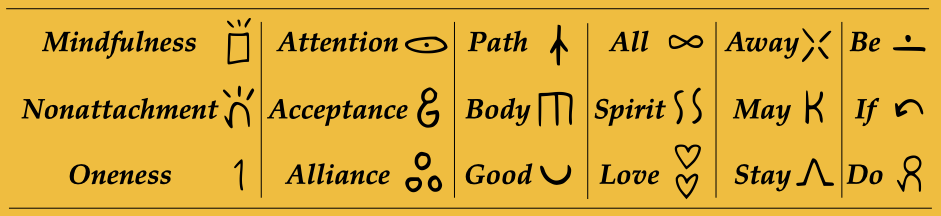
For Mindfulness + Nonattachment + Oneness Insight suggestions see https://insight.tiddlyhost.com/ — a backup copy is at https://zhurnaly.com/insight/. For physical Insight Cards (and Dice!) see Insight. Thank you!
Be aware, and be thankful — for all the good in the world, for the unity of all things, for the love that fills the universe.
... in Toki Pona, something like:
ale li pona
ale li wan
ale li olin
| toki pona | loose translation |
|---|---|
| ale li pona | it's all good |
| ale li wan | it's all one |
| ale li olin | it's all love |
(cf Mantra - Fine and One and Blessed (2016-09-23), Michael Gerson, R.I.P. (2022-11-19), ...) - ^z - 2026-09-06
- Sunday, September 06, 2026 at 06:27:23 (EDT)
On the themes of nonattachment and its conceptual partner, acceptance, Rick Hanson suggests:
"... Let good things come into the space that's been opened up by whatever you've let go. These could be more time, freedom, energy, peace, creativity, or love. ..."
... in Toki Pona, perhaps:
sina weka e ijo ike la, sina ken jo e ijo pona
sina ken jo e tenpo, jo e ken, jo e wawa, jo e pona, jo e pali, jo e olin
| toki pona | loose translation |
|---|---|
| sina weka e ijo ike la, sina ken jo e ijo pona | if you remove bad things, you can hold good things |
| sina ken jo e tenpo, jo e ken, jo e wawa, jo e pona, jo e pali, jo e olin | you can hold time, possibility, strength, goodness, creativity, love |
(cf Hanson on Letting Go (2018-01-17), ...) - ^z - 2026-09-05
- Saturday, September 05, 2026 at 16:00:45 (EDT)
As Johann Wolfgang von Goethe suggested:
"One ought, every day at least, to hear a little song, read a good poem, see a fine picture, and, if it were possible, to speak a few reasonable words."
... in Toki Pona:
tenpo suno ale la
o kute e kalama lili pona
o lukin e lipu lili pona
o toki e nimi lili pona
| toki pona | loose translation |
|---|---|
| tenpo suno ale la | every day |
| o kute e kalama lili pona | hear a few good sounds |
| o lukin e lipu lili pona | see a few good pages |
| o toki e nimi lili pona | say a few good words |
(cf Conversations in Paint (2000-08-18), Habitual Virtue (2008-12-18), Mantra - Hear, Read, See, Speak (2018-01-30), ...) - ^z - 2026-09-04
- Friday, September 04, 2026 at 17:49:12 (EDT)
A Quanta Magazine article in "The Joy of Why" series (20 Aug 2026) is titled "Computer scientist Melanie Mitchell discusses why artificial intelligence doesn’t “think” or “reason” like humans, and how we can create better methods for measuring machine cognition." The interviewers, Steven Strogatz and Janna Levin, chat with Mitchell about themes in her May 2026 paper "Six principles for evaluating cognitive capabilities in AI models" in AI Magazine. Some intriguing, thoughtful bits, starting about a third of the way into the transcript:
STROGATZ: Yeah, let’s get into that now because that’s really where I wanted to go with you. It’s a nice phrase, the science of AI. I’d like to encourage people to look at this article of yours, Melanie, about the six principles to assess cognitive capacity of AI. But just, as a teaser, could you enunciate what are those six and say a little about them?
MITCHELL: Sure. So the first one is to be aware of your own anthropomorphic cognitive biases. So we tend to project human likeness onto things that talk to us in fluent English. So people very much think that these models have human-like qualities when maybe they actually don’t.
The second one’s a very common sense one for scientists. Be skeptical of hypotheses and develop control experiments. That’s just like Science 101, although I’m not sure how often it’s really followed through in science. People tend to like their own hypotheses.
The third is to develop novel variations of your stimuli or your benchmark items in order to test robustness and generalization.
Uh, the fourth one is these systems don’t have to be black boxes. You can probe them in many different ways and we need more people who are very curious about why they’re getting the results that they do get.
Fifth principle is to consider performance versus competence, sort of what you can show that you can do versus what you actually can do, and in the paper I give some examples of that.
The sixth is to analyze failure types and to embrace any negative results. We tend to put papers with negative results in a drawer and forget about them, but actually they can be incredibly enlightening.
... Mitchell explains a bit later, after describing the "Clever Hans" effect:
... most of AI research is done by people whose background is in computer science or a related field that’s not focused on experimental methodology. I’m a computer scientist. I never had to take a course in experimental methodology. No such course was ever offered to me in my department. It wasn’t seen as part of what computer science was all about, and I think that’s one of the things that’s lacking in today’s AI discussion. How can we trust the results of these experiments and studies that are done that show that AI can do all these different things?
... and then, re the various dimensions of "understanding" something:
MITCHELL: So competence versus performance is kind of an old distinction from psychology and linguistics. The idea is that you might have the competence for a particular cognitive capacity, but there might be some reasons why you can’t perform the task that I’m giving you. Like they have the competence, they could solve the problems, but they’re just emotionally frozen. There’s some performance block.
But then there’s the other way around, which is performance without competence. So if the student in your office hours, say, had memorized a problem from the textbook and the solution, but they didn’t understand the general principle, so if you gave them a slightly different version of the problem, they couldn’t do it. That’s performance without competence.
... and:
... jobs as a whole are not the same as just one independent task after another. This is, I think it’s almost like a fallacy that if an AI system can do a bunch of tasks, it can do the job of a person that is associated with those tasks.
... and nearer the end:
MITCHELL: ...why do we do science in the first place? I mean, you know, we do science ’cause we wanna solve problems. That’s one thing. But we also do science ’cause we’re driven to understand things.
STROGATZ: Yes.
MITCHELL: You see this in little children. They’re driven to understand. Often one of their first words is why. They ask it constantly. So I think that’s a human drive, and it’s hard to fight against that. And that’s why you and I both went into science, it’s important to us.
Now, I was a little despairing when I went to a panel discussion at a conference on the role of AI in science. And there were a bunch of famous people on the panel talking about how AI was going to revolutionize weather prediction, and genetics, and cosmology, and you name it. And I asked them at the end “Well, like, is this going to contribute to human understanding of the world?” And they’re like, “Why should we care about that?”
... and finally as the hosts of the broadcast, Levin & Strogatz, chat with each other:
... in our own lives, very often we’re not the best. I’m certainly not the best tennis player. I love to play tennis. I’m not the best chess player, and I’m still happy to play chess. And try to be the best dad, but I may not be. But still, all these things are worth doing for their own sake, right? They give us pleasure.
I do feel very philosophical and almost religious about this. Like, we get a little time on Earth alive and, you know, these questions about AI do tap into questions about the meaning of life. What are we trying to do? If the meaning of life is that you’re gonna be the best in some domain or you’re gonna make a discovery that’s gonna change the world, then most people will have a meaningless life, and I just don’t wanna believe that’s the correct version of the meaning of life.
Wonderful comments!
(cf Genius and Complexity (1999-05-25), Intelligence Augmentation (2001-08-25), Mind Children (2003-04-17), Superfluid Intelligence (2018-06-09), Finding Meaning in an Imperfect World (2025-02-20), World Models vs Large Language Models (2026-01-28), ...) - ^z - 2026-08-22
- Saturday, August 22, 2026 at 21:57:40 (EDT)
Life Partner Criteria analyzed factors that a dear friend suggested in ranking a potential mate. In Toki Pona, perhaps they could be loosely translated as something like:
sona suli
olin tawa jan lili
pilin suli
pilin tawa jan olin
pilin tawa kon
pilin wawa
pana tawa jan pi wile suli
sona mani
jo sona
wile sona tawa pali ma
kon pona sijelo
musi suli
pali sijelo suli
pali pona tawa jan olin
| toki pona | loose translation | original English |
|---|---|---|
| sona suli | big knowing | Intellect |
| olin tawa jan lili | love for small people | Love of children |
| pilin suli | big feeling | Sensitivity |
| pilin tawa jan olin | feelings for beloved people | Affection |
| pilin tawa kon | feelings for spirits | Spirituality |
| pilin wawa | feeling powerful | Confidence |
| pana tawa jan pi wile suli | giving toward people of great need | Altruism |
| sona mani | money wisdom | Financial Stability |
| jo sona | getting knowledge | Education |
| wile sona tawa pali ma | wanting knowledge about land happenings | Interest in world events |
| kon pona sijelo | good body spirit | "Chemistry" |
| musi suli | big laughter | Humor |
| pali sijelo suli | great bodily doing | Physical activity |
| pali pona tawa jan olin | doing good for beloved people | Chivalry |
(cf Classy People (2000-04-01), Check Mate 1 (2001-11-26), Check Mate 2 (2001-11-30), Life Partner Criteria (2014-05-15), Comments on Life Partner Criteria (2015-02-16) ...) - ^z - 2026-07-30
- Thursday, July 30, 2026 at 10:23:33 (EDT)
In the July 2026 essay on market mania "Mountain, Cliff, or Ocean by John P. Hussman, there's the thoughtful comment on the awakened life:
... Mountain, cliff, or ocean in the distance, we choose our footing for the terrain beneath us. Rather than attaching ourselves to forecasts and views, we’re content to respond with our best mindfulness as the evidence changes.
In Toki Pona, briefly, perhaps:
ma kiwen sewi anu ma pakala sewi anu ma telo sewi la, mi tawa pona tan ma anpa
ijo sona ante la, mi lon sona lawa pona
| toki pona | loose translation |
|---|---|
| ma kiwen sewi anu ma pakala sewi anu ma telo sewi la, mi tawa pona tan ma anpa | in highlands or on shattered lands or on the oceans, we travel well based on the realm below |
| ijo sona ante la, mi lon sona lawa pona | when known things change, we are mindful |
(cf Light Mind (2002-08-22), Slow Down (2013-01-15), Resilience Training (2022-10-03), ...) - ^z - 2026-07-15
- Wednesday, July 15, 2026 at 12:09:01 (EDT)
Boundaries are important! From "Pause on Each Threshold" in Meditation Made Easy by Lorin Roche:
Being healthy in meditation depends on respecting your own boundaries, your own limits and preferences, your yes-and-no structure. When you learn to enjoy your boundaries and be balanced within them, then the possibility of experiencing a larger boundary arises. There are moments here and there in meditation that seem “boundless.” For instance, in a breathing meditation, sometimes you may feel intimate with the ocean of air embracing the planet and embracing your body. In fact, if you pursue meditation, it is almost inevitable that you will have experiences of boundlessness. This makes it all the more important to develop your appreciation and respect for boundaries, as well as to witness the kinds of contact that occur on borders. Start by observing the feelings in your body as you cross thresholds.
In Toki Pona, perhaps briefly:
o olin e selo sijelo
o olin e selo kon
o olin e selo ale
| toki pona | loose translation |
|---|---|
| o olin e selo sijelo | love the boundaries of the body |
| o olin e selo kon | love the boundaries of the spirits |
| o olin e selo ale | love all boundaries |
(cf Stokes Theorem (2006-01-27), Meditation Made Easy (2008-11-01), Mantra - Be Early (2015-04-19), Meditation Secrets - FAQ (2023-07-13), Mantra - Pause on Each Threshold (2023-07-29), ...) - ^z - 2026-07-12
- Sunday, July 12, 2026 at 19:39:15 (EDT)
Melissa Kirsch's thoughtful Saturday NYT newsletter article "Natural Selection" muses about "evolving" one's life. Its subtitle: Sometimes, our preference for certitude, our need to define things with conviction, closes us off from possibility. The essay riffs off a comment by tennis superstar Serena Williams. Kirsch comments on non-attachment:
... I love the idea of looking at one’s life more objectively, without so much judgment: I’m evolving away from this person, this job, this particular chapter, and who’s to say I won’t evolve back?
and:
... We love what we’re doing, but we’re leaving it, on our own terms, and we’re looking forward to the next chapter. Moving away from one thing without rancor, moving toward something else with enthusiasm.
She ends with some excellent questions:
.. Where can I narrate my own experience with more spaciousness? ... What elements of our own lives could benefit from some less definitive framing? What are we leaving behind that, who knows, we might want to one day revisit?"
In Toki Pona, a summary could perhaps look like:
mi weka e ni
taso tenpo ante la, mi ken kama tawa ni
| toki pona | loose translation |
|---|---|
| mi weka e ni | i'm leaving this |
| taso tenpo ante la, mi ken kama tawa ni | but at another time, perhaps i will return to this |
(cf You're doing great. Keep going. (2022-12-18), Mental Landscape (2024-02-04), Mantra - Move the Horizon Closer (2025-06-15), Mid-Year Resolutions (2025-06-30), Dancing Is an Act of Remembering (2025-12-13), Be Kind to Future You (2026-02-22), ...) - ^z - 2026-07-07
- Tuesday, July 07, 2026 at 12:11:20 (EDT)
Charles Dickens, in David Copperfield (Chapter XXXV) writes:
... But, if any fraud or treachery is practising against him, I hope that simple love and truth will be stronger, in the end. I hope that real love and truth are stronger in the end than any evil or misfortune in the world. ...
In Toki Pona, maybe:
wile mi la, olin en lon li wawa suli
wile mi la, ike li wawa lili
| toki pona | loose translation |
|---|---|
| wile mi la, olin en lon li wawa suli | my wish is that love and truth be powerful |
| wile mi la, ike li wawa lili | my wish is that evil be weak |
(cf David Copperfield on Busy Mischief (2006-06-23), David Copperfield on Indifference (2006-08-18), ...) - ^z - 2026-07-04
- Saturday, July 04, 2026 at 12:33:06 (EDT)
A saying of Rabbi Tarfon, quoted in Pirkei Avot (2:16):
You are not obliged to complete the work, but neither are you free to desist from it.
In Toki Pona, maybe:
sina wile ala pini e pali
taso sina wile awen e pali
| toki pona | loose translation |
|---|---|
| sina wile ala pini e pali | you need not finish the work |
| taso sina wile awen e pali | but you need to continue the work |
(cf Staying the Course (2005-07-11), Giving Up Hope (2014-09-01), ...) - ^z - 2026-06-23
- Tuesday, June 23, 2026 at 12:07:15 (EDT)
In Chapter 1 of What You Are Looking for Is in the Library by Michiko Aoyama, one character observes:
| "In a world where you don't know what will happen next, I just do what I can right now." |
In Toki Pona, perhaps something like:
lon ma ni la, mi sona ala e kama
ni la, mi pali e ken pi tenpo ni
| toki pona | loose translation |
|---|---|
| lon ma ni la, mi sona ala e kama | in this world, i do not know what comes |
| ni la, mi pali e ken pi tenpo ni | thus, i do what is possible now |
(cf Only Get Better (2017-04-14), Tikkun Olam (2019-12-11), Mantra - Greater Love (2020-02-21), Two Thoughts (2020-10-02), Morning Cup of Yoga (2021-07-17) ...) - ^z - 2026-06-20
- Saturday, June 20, 2026 at 18:18:06 (EDT)
From Audubon Magazine March 2026 article "What It’s Like Inside the Brain of An Expert Birder" (subtitled "Neuroscientist Erik Wing talks us through his new research, which reveals how birding can literally reshape the mind."):
... Initially, lots of things get confused, and everything is new. A few months later, you start to differentiate birds that used to confuse you, and you make better mistakes. ...
In Toki Pona, briefly:
o pali e pakala pona a
| toki pona | loose translation |
|---|---|
| o pali e pakala pona a | make good mistakes! |
(cf Good Mistakes (1999-09-06), ...) - ^z - 2026-06-08
- Monday, June 08, 2026 at 09:59:35 (EDT)
A proverb from David French's column in today's New York Times:
| Shared joy is double joy. Shared sorrow is half sorrow. |
In Toki Pona, perhaps:
pona pana li suli tu
ike pana li lili tu
| toki pona | loose translation |
|---|---|
| pona pana li suli tu | good given is big twice |
| ike pana li lili tu | sad given is little twice |
(cf Shared Pain (2010-04-07), Mantra - At Your Side (2015-09-18), Unconditional Friendliness (2018-08-10), Alliance (kulupu), ...) - ^z - 2026-06-04
- Thursday, June 04, 2026 at 08:49:11 (EDT)
From the novel Dracula, by Bram Stoker, great mindfulness in Chapter XXIII, when Mina Harker – bitten by Count Dracula himself, starting to fall under his evil influence – counsels pity and mercy, even when struggling against the greatest of wickedness. She reminds everyone that love, not hatred, is key:
"... I want you to bear something in mind through all this dreadful time. I know that you must fight — that you must destroy even as you destroyed the false Lucy so that the true Lucy might live hereafter; but it is not a work of hate. That poor soul who has wrought all this misery is the saddest case of all. Just think what will be his joy when he too is destroyed in his worser part that his better part may have spiritual immortality. You must be pitiful to him too, though it may not hold your hands from his destruction. ..."
In Toki Pona, this might be something like:
sina wile utala
taso sina wile ala pilin ike tawa jan ike
sina wile pilin olin tawa ona
o utala a
taso o pana e pona tawa ike a
| toki pona | loose translation |
|---|---|
| sina wile utala | you must fight |
| taso sina wile ala pilin ike tawa jan ike | but you must not feel hate toward the enemy |
| sina wile pilin olin tawa ona | you must feel love toward him |
| o utala a | o fight! |
| taso o pana e pona tawa ike a | but give good to evil! |
(cf Just Desserts (1999-09-20), Ethical Fitness (2000-12-15), Aikido Spirit (2003-12-09), Gentleness, Sensitivity, Compassion (2014-03-09), Mantra - Love, Simplicity, Humility (2016-03-29), ...) - ^z - 2026-05-19
- Tuesday, May 19, 2026 at 12:31:35 (EDT)
In Philosophy Now magazine #172 (Feb/Mar 2026), Cassandra Brandt (paralyzed after a car accident) writes in "The Post Paralysis Peace Paaradox" about "seven elements within Stoic philosophy that were a catalyst in building a new life":
... which, perhaps, in Toki Pona might be something like:
o jo e lon
o pilin e kalama ala
o awen suli
o lukin pona tawa lon
o pali e pona
o lon pona
o pilin e olin
| toki pona | loose translation |
|---|---|
| o jo e lon | hold what is |
| o pilin e kalama ala | feel the quiet |
| o awen suli | stay greatly |
| o lukin pona tawa lon | look well toward what is |
| o pali e pona | create the good |
| o lon pona | act well |
| o pilin e olin | feel the love |
(cf Ethical Fitness (2000-12-15), Franklin's Virtues (2008-05-23), Habitual Virtue (2008-12-18), Humility, Virtue, Honour (2023-06-08), Various Virtues (2023-08-24), Classical Virtues (2024-04-14), ...) - ^z - 2026-05-12
- Tuesday, May 12, 2026 at 15:35:05 (EDT)
From Jonathan Adler, potter, author, decorator:
| "When it comes to decorating there are no rules: if you love it, it will work." |
In Toki Pona, perhaps:
sitelen tomo pi pona suli la, nasin li lon ala
sina olin e ona la, ona li pona
| toki pona | loose translation |
|---|---|
| sitelen tomo pi pona suli la, nasin li lon ala | concerning household images of greatest beauty, rules do not exist |
| sina olin e ona la, ona li pona | in the context of your loving something, it is good |
(cf Rules vs Principles (1999-06-23), ...) - ^z - 2026-05-11
- Monday, May 11, 2026 at 17:47:27 (EDT)
Economist Paul Krugman sporadically has quoted from "Issawi's Laws of Social Motion" – a "... light-hearted, yet profoundly serious, commentary on life and letters", as the illustrated book is described in an obituary of Charles Issawi, Egyptian-American economist and historian (1916-2000). The aphorisms it offers begin with:
In Toki Pona, perhaps:
mute ike insa ijo li sama ale
tenpo kama la, ijo mute li kama lon ike
nasin lili li nasin suli
| toki pona | loose translation |
|---|---|
| mute ike insa ijo li sama ale | the amount of badness inside a thing is the same always |
| tenpo kama la, ijo mute li kama lon ike | in times to come, many things will come to be bad |
| nasin lili li nasin suli | a short path is a long path |
(cf Future Generations (2011-01-19), What a Drag It Is Getting Old (2017-03-04), o kama ala e ko jaki (2025-06-27), ...) - ^z - 2026-05-09
- Saturday, May 09, 2026 at 07:46:56 (EDT)
| MDCCCLII FOUNDED THROUGH THE MUNIFICENCE AND PUBLIC SPIRIT OF CITIZENS THE PUBLIC LIBRARY OF THE CITY OF BOSTON BUILT BY THE PEOPLE AND DEDICATED TO THE ADVANCEMENT OF LEARNING A.D. MDCCCLXXXVIII THE COMMONWEALTH REQUIRES THE EDUCATION OF THE PEOPLE AS THE SAFEGUARD OF ORDER AND LIBERTY |
That's what's written on the façade of the main building of the Boston Public Library. In Toki Pona, perhaps part of it could be said as:
tomo ni pi lipu sona li pali tan jan, li tawa pona e kama sona ona
awen kulupu la kulupu li wile e sona jan
| toki pona | loose translation |
|---|---|
| tomo ni pi lipu sona li pali tan jan, li tawa pona e kama sona ona | this building of books was made by the people, and is for the betterment of their learning |
| awen kulupu la kulupu li wile e sona jan | to protect the commmunity, the community needs educated people |
(cf Education of the Youth (2001-12-01), Boston Public Library (2002-06-20), Knowledge and Public Happiness (2003-07-29), Vartan Gregorian and Andrew Carnegie (2010-05-05), ...) - ^z - 2026-05-07
- Thursday, May 07, 2026 at 21:20:53 (EDT)
"Chaucer Doth Tweet", formerly on Twitter now on Bluesky, recently posted a lovely thought about AI/LLM:
In modern English, roughly:
"Ich askid ChatGPT." Well Ich askid the stones, and the forest, and the starres, and the mountaynes, and the moone daunsinge above, and what thei seyde was learninge, and dreames, and growinge thinges, and makinge art, and a worlde wher we talke to each othir and care about each othir.
In Toki Pona, perhaps something akin to:"I asked ChatGPT". Well, I asked the stones, and the forest, and the stars, and the mountains, and the moon dancing above, and what they said was learning, and dreams, and growing things, and making art, and a world where we talk to each other and care about each other.
mi toki tawa ma kiwen, tawa ma kasi, tawa mun mute, tawa ma nena, tawa mun musi
ona toki tawa mi la: o kama sona, o pilin lawa, o pali pona, o toki tawa jan ale, o olin e ale
| toki pona | loose translation |
|---|---|
| mi toki tawa ma kiwen, tawa ma kasi, tawa mun mute, tawa ma nena, tawa mun musi | i spoke to the hard land, and the plant-covered land, and the many celestial bodies, and the mountains, and the playful moon |
| ona toki tawa mi la: o kama sona, o pilin lawa, o pali pona, o toki tawa jan ale, o olin e ale | they said to me: learn, and feel with your head, and create goodness, and speak to everyone, and love everything |
(cf Moon Over Water (2012-02-12), Chaucer Doth Tweet (2020-05-23), ...) - ^z - 2026-05-06
- Wednesday, May 06, 2026 at 11:04:01 (EDT)
From Chapter 3 of The Dharma of the Princess Bride by Ethan Nichtern:
... and ...
... In the flow of time, achieving a result is just one more moment, one of many. Reality offers no particular privilege to our subjectively defined "big" moments. The space-time continuum does not hold annual award ceremonies. Big moments are a construct. There is nothing wrong with a construct, as long as we don't forget that we built it ourselves. Viewing life as a practice gives you the opportunity to look at experience as a progression, continuous instead of finite, analog rather than digital. A practice involves working to cultivate qualities and attitudes, rather than accumulating trophies bound to tarnish and disintegrate. Our sense of time does not need to be reduced to the anxious buildup to a few anticipated "big" moments, followed by the longer-lived letdown when those moments fade. Mindfulness allows us to see that more moments matter than we previously were willing to acknowledge. Maybe, just maybe, all the moments matter.
... in Toki Pona, perhaps something like:… the practice of awakened friendship includes the cultivation of three core qualities, and these three qualities are what help transform delusion, hatred, and greed, respectively. These three qualities are trust, inspiration, and generosity.
tenpo lili ale li suli
jan pona li ken pana e pona
lon sewi tu wan li pilin e jan pona, li alasa e sona pona, li pana e pona suli
| toki pona | loose translation |
|---|---|
| tenpo lili ale li suli | all moments are important |
| jan pona li ken pana e pona | friends can give goodness |
| lon sewi tu wan li pilin e jan pona, li alasa e sona pona, li pana e pona suli | three supreme qualities are feeling good friendship, finding good ideas, and giving great goodness |
(cf Best Friend (2026-01-31), ...) - ^z - 2026-05-05
- Tuesday, May 05, 2026 at 16:40:33 (EDT)
"Self-Discovery, Skills of Mind, Generosity of Heart"— motto of the Field School in Washington, DC – perhaps, in Toki Pona, something like:
o kama sona e lon sina
o pali e sona lawa
o pana suli tan pilin
| toki pona | loose translation |
|---|---|
| o kama sona e lon sina | come to know your self |
| o pali e sona lawa | develop skills of mind |
| o pana suli tan pilin | give big from the heart |
(cf 2019-06-16 - Self-Discovery, Skills of Mind, Generosity of Heart (2019-07-07), Genuine, Gallant, Generous, Grateful, Good (2023-09-16), ...) - ^z - 2026-05-04
- Monday, May 04, 2026 at 12:58:51 (EDT)
Thoughts to ponder from David Bessis's essay "The fall of the theorem economy", subtitled "How AI could destroy mathematics and barely touch it" (21 April 2026):
In my book Mathematica: a Secret World of Intuition and Curiosity, I framed the misunderstanding as the tension between two versions of mathematics, official math and secret math. Official math manifests itself as a formal deduction system where you start from axioms and mechanically derive theorems. This is a nerd’s paradise, a world where truth takes binary values, reasoning is either valid or invalid, and there is technically no room for bullshit. Secret math is the human part of the story–why official math was invented, how we can successfully interact with it, its effects on our brains, and the bizarre mental techniques through which mathematicians continuously expand its territory. Secret math never made it to the curriculum, because it lacks the defining qualities of official math, and also because it feels peripheral. Official math is cold, hard, logical, objective, and it is rumored to be the language of the universe. Secret math is soft, fuzzy, subjective and, by contrast, it looks like cheap pedagogical backstory. No wonder professional mathematicians have such a dissociative view of their job. The first rule of the Intuition Club is: you don’t talk about the Intuition Club. ...
In Toki Pona, perhaps something like:
sona nanpa li jo e lon tu:
nasin
kon
nasin pi sona nanpa li kiwen, li ilo, li lukin
kon pi sona nanpa li ko, li suwi, li len
o toki ala li kon pi sona nanpa a
| toki pona | loose translation |
|---|---|
| sona nanpa li jo e lon tu: | mathematics has two realities: |
| nasin | system |
| kon | spirit |
| nasin pi sona nanpa li kiwen, li ilo, li lukin | the system of math is solid and mechanical and visible |
| kon pi sona nanpa li ko, li suwi, li len | the spirit of math is gooey and soft and hidden |
| o toki ala li kon pi sona nanpa a | do not talk about the spirit of math! |
(cf Greatest Inventions (2011-06-09), Clarity, Understanding, Community (2020-09-03), Mathematica by David Bessis (2025-10-09), ...) - ^z - 2026-05-01
- Friday, May 01, 2026 at 13:40:04 (EDT)
In Latin, Seneca's "Non scholæ sed vitæ" is a short aphoristic form of "Non scholæ sed vitæ discimus" meaning "We do not learn for school, but for life." In Toki Pona, perhaps it could be rendered something like:
o kama sona tan ala tomo sona,
taso tan kon ale
| toki pona | loose translation |
|---|---|
| o kama sona tan ala tomo sona, | come to knowledge not for the schoolhouse, |
| taso tan kon ale | but for all of Life |
Many thanks to jan Wena for helpful advice!
(cf Keep Out (2001-12-17), Ruddock House Mottos (2007-03-11), Garden and Library (2023-06-25), ...) - ^z - 2026-04-24
- Friday, April 24, 2026 at 20:42:42 (EDT)
| “Realize you are future you to past you. Have you thanked yourself for everything you’ve done?” |
Snippets from a charming-thoughtful-wise essay by Melissa Kirsch, "Future Perfect", in the New York Times morning newsletter of 21 Feb 2026:
... It can feel like a drag to do something uncomfortable now in order to reap the benefits later — see: saving for retirement, going to the gym. In some cases, the future payoff feels worth it; in others, not so much. I watch the way I alternately take care of Future Me and then sabotage her nearly every night. ...
... and ...
... Deciding to back into the [parking] space, taking a few minutes to clean up before bed: These are tiny expressions of care for one’s near-future self. We reap the benefits almost immediately after the sacrifice. It can be harder to envision who we’ll be decades from now, to really imagine our future selves and invest in setting them up for success. We engage in temporal discounting, valuing the rewards of the present over those of the future. We spend the bonus instead of putting it in a high-yield savings account. We know that our future self awaits, but sometimes we decide to satisfy the present self instead. ...
Yes – the challenge is balance ...
(cf Zhurnal Themes (2003-04-04), Honor Your Practice (2013-01-04), Future Self (2022-01-22), toki sona - o pana e pona tawa sina pi tenpo kama (2024-08-28), ...) - ^z - 2026-02-22
- Sunday, February 22, 2026 at 07:21:46 (EST)
The 2026 book Eat Your Ice Cream by Dr Ezekiel Emanuel is a fast, fun, data-driven romp through obvious – and obviously important – information about how to live a healthier life. The best advice of all, buried in the middle of the chapter on diet (lightly edited for style and concision):
Don't obsess. Do what you can, and make it habit that fits into your life. Don't get overwhelmed and do nothing.
Some key points to remember (and practice!), as per the Table of Contents:
... and from the Afterword, Be a Mensch:
Dr Emanuel's bottom line:
Be a mensch. Keep sight of the reasons you want to live longer. Don't just try to accumulate years of life without appreciating their value.
And what's missing from this book? Besides the lack of an index, there's little or no discussion of sex, love, life-partnerships, poverty, or disease. Epidemiological data are presented inconsistently. The author's personal passions (e.g., chocolate and cooking) get more coverage than they merit. And the title is inaccurate and deceptive – Emanuel's actual advice about ice cream includes multiple caveats about not indulging often or to excess.
But those are all minor nits compared to the balanced, solid advice that Eat Your Ice Cream offers. The challenge, of course, is to do it!
(cf Franklin's Virtues (2008-05-23), Disease as Journey (2009-12-16), Happier and Healthier (2020-07-08), Retirement Mental Health Advice (2023-05-25), Recovery to Health (2023-09-18), Mantra - Community, Health, Adventure, Purpose (2024-02-18), Celebrate Healthy Habits (2025-01-07), Better Brains via Exercise, Diet, Thinking, and Friendship (2025-08-08), ...) - ^z - 2026-02-19
- Thursday, February 19, 2026 at 08:11:37 (EST)
From the Los Angeles Times obituary "Robert Duval, actor who specialized in tightly wound men, has died":
When asked about his acting technique, Duvall would describe it as simply as his favorite character — Augustus McCrae, the wry trail boss on the TV miniseries “Lonesome Dove” — might have described riding a horse.
“It’s just talking and listening,” Duvall told The Times in 2006. “Nothing’s precious. Just let it sit there and find its own way.”
(cf Charlotte Joko Beck (2014-08-18), Nothing Happens Next - This Is It (2017-02-10), 2018-12-31 - Nothing Special, ...) - ^z - 2026-02-17
- Tuesday, February 17, 2026 at 10:17:57 (EST)
From Nicholas Kristof's New York Times op-ed essay "What if the Valedictorians in America’s Schools Were the Cool Kids?" (7 Feb 2026):
As America’s democracy and society have struggled in recent years, caught in an authoritarian riptide and mired in inequality and discontent, I’ve wondered about the lessons that we Americans can learn from some of the successes of Asia.
The one I focus on is the transformative power of education. It’s not a new thought, of course, and it’s one I’ve puzzled over since my wife and I began visiting schools in Asia in the 1980s and sending our kids to school in Japan in the 1990s. Every time I visit, I feel a pang of envy for societies that seem to value education more than America does.
The passion reflects a tradition in the Confucian belt of East Asia that the path to glory is to study. Even today in Chinese villages, you occasionally come across an ancient “paifang” monument to some local man who centuries ago earned a “jinshi” degree with top honors in the imperial exams. (When was the last time you saw an American village commemorating a local Ph.D.?)
In a modern echo, in some East Asian schools I’ve visited, students and teachers alike have explained that the “hot” girls and boys are the valedictorians. It’s nerd heaven, and this set of values leads many students to work extraordinarily hard.
... and Kristof's conclusion:
… Maybe we could acknowledge the inequity of local school finance that results in sending rich kids to good schools and poor kids to weak schools? Perhaps politicians could stop demonizing universities and taxing their endowments? What if we respected human capital as much as financial capital?
... and in a Toki Pona nutshell, perhaps something like:
kama sona li suli sewi
| toki pona | loose translation |
|---|---|
| kama sona li suli sewi | getting knowledge is of highest importance |
(cf Education, Culture, and Blame (2000-06-01), Education of the Youth (2001-12-01), Freedom Peace Commerce Education (2002-09-13), Liberal Education (2005-11-02), Vartan Gregorian on Libraries (2010-04-23), ...) - ^z - 23026-02-09
- Monday, February 09, 2026 at 10:09:39 (EST)
From an interview of Michelle Cottle by Vishakha Darbha, "Our Health Care System Isn’t Built for You to Get Old" in the New York Times, some wise suggestions for caregivers:
... don’t grind this out by yourself. That’s my No. 1 piece of advice. And give yourself some grace. Take care of yourself. You can run yourself ragged, and you can beat yourself up because you’re not going to be perfect at this, and you’re going to drop the ball sometimes, but you’re doing the best you can. ...
(cf LOOPY - Caregiving vs Caretaking (20212-09-30), Navigating Ambiguous Loss (2021-12-28), Partner Change and Changing (2022-04-28) , ...) - ^z - 2026-02-06
- Friday, February 06, 2026 at 09:39:32 (EST)
... from Chapter 1 of The Dharma of the Princess Bride by Ethan Nichtern:
... a Buddhist definition for best friend could simply be the person who helps you bring out your "best" qualities: mindfulness, generosity, patience, confidence, and creativity. The best friends are the ones who support your awakening and whose awakening you in turn support. ...
... and in Toki Pona, perhaps something like:
sona sewi la, jan pona sewi li pali e pona sewi sina
ni li lon sona sewi, li lon pana sewi, li lon awen sewi, li lon wawa sewi, li lon pali sin sewi
ona li pona tawa sona sewi sina
sina pona tawa sona sewi ona
| toki pona | loose translation |
|---|---|
| sona sewi la, jan pona sewi li pali e pona sewi sina | in the context of wisdom, a best friend builds great good in you |
| ni li lon sona sewi, li lon pana sewi, li lon awen sewi, li lon wawa sewi, li lon pali sin sewi | that is, great knowing, great giving, great waiting, great power, and great creation |
| ona li pona tawa sona sewi sina | they are good for your wisdom |
| sina pona tawa sona sewi ona | you are good for their wisdom |
(cf Unicorn - Best Friends, Buddha Buddy (2014-05-19), Mantra - Be Your Own Best Friend (2016-02-16), Mantra - We Are One (2017-04-18), Best Frever (2021-07-14), 2021-07-17 - Best Friends, Genuine, Gallant, Generous, Grateful, Good (2023-09-16), Zhiji (2024-09-20), ...) - ^z - 2026-01-31
- Saturday, January 31, 2026 at 10:07:32 (EST)
Gary Marcus's essay "Generative AI’s crippling and widespread failure to induce robust models of the world" (28 June 2025) is thoughtful, longish, semi-technical, and worth reading. In brief:
(cf Genius and Complexity (1999-05-25), Intelligence Augmentation (2001-08-25), Mind Children (2003-04-17), Taxonomy of Machine Learning (2017-02-02), ...) - ^z - 2026-01-28
- Wednesday, January 28, 2026 at 09:56:32 (EST)
From The Federalist Papers #51, by James Madison, in 1788:
… If men were angels, no government would be necessary. If angels were to govern men, neither external nor internal controls on government would be necessary. In framing a government which is to be administered by men over men, the great difficulty lies in this: you must first enable the government to control the governed; and in the next place oblige it to control itself. …
... and in Toki Pona, perhaps something like:
jan li ijo sewi la, lawa li wile ala
ijo sewi li lawa e jan la, lawa lawa li wile ala
lawa tan jan tawa jan la, lawa lawa li pali ike
lawa wile lawa e jan
lawa wile lawa e lawa
| toki pona | loose translation |
|---|---|
| jan li ijo sewi la, lawa li wile ala | if people were sacred beings, government would not be needed |
| ijo sewi li lawa e jan la, lawa lawa li wile ala | if sacred beings governed people, rules for government would not be needed |
| lawa tan jan tawa jan la, lawa lawa li pali ike | if government is by people for people, rules for government are difficult to create |
| lawa wile lawa e jan | government must rule people |
| lawa wile lawa e lawa | government must rule itself |
(cf Gibbon - Thoughts Upon Reading (?), Ideas and Arguments (2000-07-22), Lyndon Johnson Political Philosophy (2006-10-06), Social Good and Partisan Politics (2021-03-02), ...) - ^z - 2026-01-23
- Friday, January 23, 2026 at 08:21:06 (EST)
From the first chapter of Ray Jackendoff's 2007 book Language, Consciousness, Culture: Essays on Mental Structure, some key comments about linguistics and thinking:
... It is my impression that of all the cognitive sciences, only linguistics has systematically and explicitly investigated the content of mental structures that underlie a human capacity. The rest of cognitive neuroscience has for the most part made do with relatively rudimentary notions of mental structure, exploring more intensely issues of neural localization and/or the "horizontal" capacities of working memory, attention, learning, and the like. ... (with the exception, Jackendoff notes, of vision, music, and some complex actions)
...
... The neurons deep inside the brain that are responsible for cognition have no privileged access to the "real world"; they interact only with other neurons. Contact with the "real world" is established only through long chains of connection leading eventually to sensory and motor neurons. If this is the hardware on which mental capacities "run," then mental capacities too are necessarily limited in their contact with the "real world." They are sensitive to the outside environment only insofar as they are connected through functional (or computational) links to the sensory and motor capacities. ...
...
Some neuroscientists say we are beyond this stage of inquiry, that we don't need to talk about "symbols in the head" anymore. I firmly disagree. We know that language is organized into speech sounds and that speech sounds are only the first step in analyzing linguistic structure. As far as I know, there exist absolutely no attempts to account for even this trivial degree of linguistic complexity in neural terms, and speech sounds only scratch the surface. In my opinion, it is the height of scientific irresponsibility to totally dismiss linguistic theory, claiming that some toy system (say a computational neural network) will eventually scale up to the full complexity of language. A linguist who made comparably ignorant claims about the brain would be a laughingstock. End of sermon. ...
...
... In both language and vision, if we want to figure out how the brain works, it behooves us to try to understand what functions the mind has to compute. A proposed theory of neural behavior is incomplete if it does not offer genuine solutions to the problems of combinatoriality, structural hierarchy, and binding among structures.
It is not that these problems are particular to language. It is just that linguistic theory focuses on these problems and builds on them in a way that theories of other "vertical" faculties of mind usually have not. Part of the message of this book is that these properties recur in other faculties, should we care to look for them. Sixty years ago, nearly everyone thought that language was perfectly transparent and hardly complex at all and many nonlinguists, even some in psychology and neuroscience, still think so). Since then we have learned that not only is language far more complex than we ever would have dreamed, but so is every other aspect of the mind/brain that has been investigated.
To sum up: Pretty much all cognitive neuroscientists agree in rejecting dualism; ultimately the mind must run in the brain, and there are no mental properties that are causally independent of brain events. However, to insist that neural accounts have absolute priority, that they somehow have a greater reality or are "more scientific" than functional accounts, to me has a chilling effect on inquiry. It seems to me that in the practice of research, the relationship between neural and functional accounts ought to be a two-way street: what we know about each dimension of the problem ought to enrich our study of the other. ...
(cf Mental Bandwidth Boosters (1999-06-26), Higher Level Language (2007-08-17), Babel-17 (2015-10-20), Patterns in the Mind (2024-05-12), ...) - ^z - 2026-01-21
- Wednesday, January 21, 2026 at 09:53:05 (EST)
From an interview "George Saunders Is No Saint (Despite What You May Have Heard)" by David Marchese in the New York Times:
... You know those three things that you’ve always thought of? They’re not true. You’re not permanent, you’re not the most important thing and you’re not separate. ...
... and in Toki Pona, perhaps:
sina lon ala pi tenpo ale
sina lon ala sewi
sina lon ala tu
| toki pona | loose translation |
|---|---|
| sina lon ala pi tenpo ale | you are not eternal |
| sina lon ala sewi | you are not supreme |
| sina lon ala tu | you are not divided |
(cf Be Kind (2021-02-27), ...) - ^z - 2026-01-10
- Saturday, January 10, 2026 at 10:32:40 (EST)
From investor-philanthropist Warren Buffett's 2025 Thanksgiving Newsletter to the shareholders of his company, Berkshire Hathaway, "A Few Final Thoughts":
One perhaps self-serving observation. I’m happy to say I feel better about the second half of my life than the first. My advice: Don’t beat yourself up over past mistakes – learn at least a little from them and move on. It is never too late to improve. Get the right heroes and copy them. You can
start with Tom Murphy; he was the best. Remember Alfred Nobel, later of Nobel Prize fame, who – reportedly – read his own obituary that was mistakenly printed when his brother died and a newspaper got mixed up. He was horrified at what he read and realized he should change his behavior. Don’t count on a newsroom mix-up: Decide what you would like your obituary to say and live the life to deserve it. Greatness does not come about through accumulating great amounts of money, great amounts of publicity or great power in government. When you help someone in any of thousands of ways, you help the world. Kindness is costless but also priceless. Whether you are religious or not, it’s hard to
beat The Golden Rule as a guide to behavior. I write this as one who has been thoughtless countless times and made many mistakes but also became very lucky in learning from some wonderful friends how to behave better (still a long way from perfect, however). Keep in mind that the cleaning lady is as much a human being as the Chairman. I wish all who read this a very happy Thanksgiving. Yes, even the jerks; it’s never too late to change. Remember to thank America for maximizing your opportunities. But it is – inevitably – capricious and sometimes venal in distributing its rewards. Choose your heroes very carefully and then emulate them. You will never be perfect, but you can always be better.
(cf Optimist Creed (1999-04-16), ...) - ^z - 2025-12-22
- Monday, December 22, 2025 at 08:35:04 (EST)
From an article about Nuno Loureiro, plasma physicist ("Slain M.I.T. Professor Was a ‘Brilliant Scientist’ and a Beloved Colleague"):
Steven Cowley, the director of Princeton Plasma Physics Laboratory and a longtime friend and colleague of Dr. Loureiro, said that his friend had managed to solve a “50-year mystery” while still in his 20s, yet maintained a sense of humor and never thought too highly of himself. “He would raise an eyebrow and look at you, and there would be a sense of irony,” said Dr. Cowley. “He had an eye for the absurd, and absolutely no pomposity. When he saw it in others, he thought it was funny.”
In explaining his job to his daughters when they were young, he said he spent his days “fighting numbers,” his family recalled in a obituary shared with The New York Times. When his daughter asked, “how many numbers did you fight today?” he often replied: “Not as many as I would have liked.”
... and:
... and in Toki Pona, perhaps:
pali mi li utala e nanpa
tenpo suno ni la sina utala e nanpa mute seme
mi wile la mi utala e mute
| toki pona | loose translation |
|---|---|
| pali mi li utala e nanpa | my work is to fight numbers |
| tenpo suno ni la sina utala e nanpa mute seme | today, how many numbers did you fight? |
| mi wile la mi utala e mute | i wish i had fought more |
(cf Hannes Alfven (2004-10-16), ...) - ^z - 2025-12-20
- Saturday, December 20, 2025 at 18:42:53 (EST)
From an intro-essay in the New York Times "Morning" newsletter (2025-12-13 – no author credit, but likely by Melissa Kirsch), "Baby steps":
... there’s excessive delight to be found on the physical plane. Babies and toddlers are un-self-conscious when they dance. They’re spontaneous, present, unconcerned with who’s watching them. This approach “brings us back to our own intelligent bodies, our own basic understanding of what it is to be alive,” a movement therapist told Margaret [Fuhrer]. “Babies don’t perform movement — they discover it.” Do adults perform movement when they dance? They do. We do. We have no choice — we’ve done it before, so each time we dance we’re re-enacting the remnants of every time we’ve danced previously. We try and fail and try again to catch the rhythm; we think about how we’re being perceived. But what a privilege it is to move, even if it’s awkward, to be embodied and expressing and trying to be responsive to a beat, to be more subject and less object. ... So much of our movement is just using our bodies like reliable vehicles to get ourselves from one place to another. Dancing is an act of remembering that, once, when we were small, everything was new. Once, we moved our bodies primarily in order to play, express and discover. The more online we become, the farther we drift from what Margaret calls “our earliest soundtrack,” the rhythm that’s in us before we’re born, “the basslike thump-thump of our mother’s heartbeat and the oontz-oontz of her circulating blood.”
... and in Toki Pona, perhaps:
tawa sijelo musi li pona sewi
| toki pona | loose translation |
|---|---|
| tawa sijelo musi li pona sewi | dancing is awesome-good |
(cf You're doing great. Keep going. (2022-12-18), Mental Landscape (2024-02-04), Mantra - Move the Horizon Closer (2025-06-15), Mid-Year Resolutions (2025-06-30), ...) - ^z - 2025-12-13
- Saturday, December 13, 2025 at 13:55:09 (EST)
Steven Barrie-Anthony's op-ed essay "I’m a Psychoanalyst. This Is What Technology Is Doing to Us." in the New York Times offers insights worth pondering:
... technology brings a kind of alexithymic fog — alexithymia being the condition of having difficulty identifying or being able to express one’s emotions. This isn’t universal, and the emotions we’re pushing away aren’t always the same. But it happens in a startlingly consistent way.
When we do manage to feel, it can be difficult to dwell with the feelings. Instead, we move swiftly into action. ...
Tech encourages the instrumentalization of emotional life, by which I mean that our feelings seem real only if they translate into actions that help us achieve specific goals. ...
... we are highly incentivized to focus on action in pursuit of external markers of success. The notion of staying with feeling without translating it into action seems pointless.
Barrie-Anthony talks about how "mindfulness", in its Western instantiation, has led to "mindfulness apps" that tally meditative minutes to feed leaderboards, with ostensible goals of helping "... de-stress, get more work done, lower your blood pressure". His conclusion:
To tackle the problems of technology we have to return to our emotional lives for their own sake, and not always leap to doing or changing or fixing. This is the only viable pathway if we are to remain in touch with our humanness and to preserve love, empathy, emotional and spiritual richness, and the capacity to create art and music that reflect our inner lives.
This echoes Jon Kabat-Zinn (in Wherever You Go, There You Are, chapter "This Is It"):
... Meditation is the only intentional, systematic human activity which at bottom is about not trying to improve yourself or get anywhere else, but simply to realize where you already are. ...
... and also Kabat-Zinn (in Coming to Our Senses, chapter "Two Ways to Think About Meditation"):
... This other way of describing meditation is that whatever "meditation" is, it is not instrumental at all. If it is a method, it is the method of no method. It is not a doing. There is no going anywhere, nothing to practice, no beginning, middle, or end, no attainment, and nothing to attain. Rather, it is the direct realization and embodiment in this very moment of who you already are, outside of time and space and concepts of any kind, a resting in the very nature of your being, in what is sometimes called the natural state, original mind, pure awareness, no mind, or simply emptiness. ...
... and Paul Wilson (in Finding the Quiet, chapter "The art of letting go"):
... be prepared to allow things to happen at their own pace. Without applying effort. Without trying to analyze in any way. And without expecting any particular outcome. ...
... and Maurine Stuart (in Subtle Sound: The Zen Teachings of Maurine Stuart, chapter "Breathing In, Breathing Out")
... The thought of practicing Zen is gone. The thought of successful practice is gone. Scattered mind is gone. There's just simply one-mindedness, and then no-mindedness: Mu-shin. Nothing seeking, or striving, or getting; just counting. Just breathing. Just being. Just this. ...
... and in Toki Pona, perhaps:
taso kon
taso lon
taso ni
| toki pona | rough translation |
|---|---|
| taso kon | just breathing |
| taso lon | just being |
| taso ni | just this |
(cf This Is It (2008-11-14), No Method (2010-01-21), Without Effort, Analysis, or Expectation (2010-08-04), This (2013-03-09), Just Breathing, Just Being, Just This (2017-04-03), ...) - ^z - 2025-11-12
- Wednesday, November 12, 2025 at 08:48:33 (EST)
From the Wikipedia page on "Meliorism":
Meliorism (Latin melior, better) is the idea that progress is a real concept and that humans can interfere with natural processes in order to improve the world. ...
... meliorism stands in the middle between optimism and pessimism and treats the salvation of the world as a probability rather than a certainty or impossibility ...
... all three statements are true at the same time: "The world is much better. The world is awful. The world can be much better." ...
(cf My Religion (2000-11-06), Tikkun Olam (2019-12-11), You Are a Poem (2020-02-10), Factfulness (2020-02-14), Two Thoughts (2020-10-02), Invisible Fixers (2021-03-26), ...) - ^z - 2025-11-06
- Thursday, November 06, 2025 at 06:54:44 (EST)
The 2000 book Meditations on Design: Reinventing Your Home With Style and Simplicity by John Wheatman has a table of contents that summarizes, mantra-fashion, big themes of awareness and connection — applicable to making a lovely living space:
... great thoughts to inspire creativity in building a personal space-time!Reinventing Your Home
Looking Inside
Bringing the Outside In
Memory and the Things You Love
The Poetics of Home
A Good Room Is Never Done
(cf Conversations in Paint (2000-08-18), Golden Rules of Interface Design (2012-07-02), Architectural Design (2016-11-04), Designing Your Life (2023-08-08), ...) - ^z - 2025-11-02
- Sunday, November 02, 2025 at 11:02:21 (EST)
From an interview "‘I’m alive, but battered’: Philip Pullman’s new novel was a struggle" by Sophia Nguyen in the Washington Post (2025-10-23), Pullman's recommendation:
... the way to write a book is to establish the habit of writing. Habit has written far more books than inspiration has. I’ll put it like this: The muse that visits the poets and brings them inspiration — if she wants to find you, she needs to know where you are. If you’re downtown drinking or watching football or something, she doesn’t know where you are. She won’t bother.
(cf Slaughter in the Hall (2006-01-11), Rules for Writing (2010-03-07), Evil Certainty (2019-12-09), ...) - ^z - 2025-10-23
- Thursday, October 23, 2025 at 13:37:36 (EDT)
For back issues of the ^zhurnal see Volumes v.01 (April-May 1999), v.02 (May-July 1999), v.03 (July-September 1999), v.04 (September-November 1999), v.05 (November 1999 - January 2000), v.06 (January-March 2000), v.07 (March-May 2000), v.08 (May-June 2000), v.09 (June-July 2000), v.10 (August-October 2000), v.11 (October-December 2000), v.12 (December 2000 - February 2001), v.13 (February-April 2001), v.14 (April-June 2001), 0.15 (June-August 2001), 0.16 (August-September 2001), 0.17 (September-November 2001), 0.18 (November-December 2001), 0.19 (December 2001 - February 2002), 0.20 (February-April 2002), 0.21 (April-May 2002), 0.22 (May-July 2002), 0.23 (July-September 2002), 0.24 (September-October 2002), 0.25 (October-November 2002), 0.26 (November 2002 - January 2003), 0.27 (January-February 2003), 0.28 (February-April 2003), 0.29 (April-June 2003), 0.30 (June-July 2003), 0.31 (July-September 2003), 0.32 (September-October 2003), 0.33 (October-November 2003), 0.34 (November 2003 - January 2004), 0.35 (January-February 2004), 0.36 (February-March 2004), 0.37 (March-April 2004), 0.38 (April-June 2004), 0.39 (June-July 2004), 0.40 (July-August 2004), 0.41 (August-September 2004), 0.42 (September-November 2004), 0.43 (November-December 2004), 0.44 (December 2004 - February 2005), 0.45 (February-March 2005), 0.46 (March-May 2005), 0.47 (May-June 2005), 0.48 (June-August 2005), 0.49 (August-September 2005), 0.50 (September-November 2005), 0.51 (November 2005 - January 2006), 0.52 (January-February 2006), 0.53 (February-April 2006), 0.54 (April-June 2006), 0.55 (June-July 2006), 0.56 (July-September 2006), 0.57 (September-November 2006), 0.58 (November-December 2006), 0.59 (December 2006 - February 2007), 0.60 (February-May 2007), 0.61 (April-May 2007), 0.62 (May-July 2007), 0.63 (July-September 2007), 0.64 (September-November 2007), 0.65 (November 2007 - January 2008), 0.66 (January-March 2008), 0.67 (March-April 2008), 0.68 (April-June 2008), 0.69 (July-August 2008), 0.70 (August-September 2008), 0.71 (September-October 2008), 0.72 (October-November 2008), 0.73 (November 2008 - January 2009), 0.74 (January-February 2009), 0.75 (February-April 2009), 0.76 (April-June 2009), 0.77 (June-August 2009), 0.78 (August-September 2009), 0.79 (September-November 2009), 0.80 (November-December 2009), 0.81 (December 2009 - February 2010), 0.82 (February-April 2010), 0.83 (April-May 2010), 0.84 (May-July 2010), 0.85 (July-September 2010), 0.86 (September-October 2010), 0.87 (October-December 2010), 0.88 (December 2010 - February 2011), 0.89 (February-April 2011), 0.90 (April-June 2011), 0.91 (June-August 2011), 0.92 (August-October 2011), 0.93 (October-December 2011), 0.94 (December 2011-January 2012), 0.95 (January-March 2012), 0.96 (March-April 2012), 0.97 (April-June 2012), 0.98 (June-September 2012), 0.99 (September-November 2012), 0.9901 (November-December 2012), 0.9902 (December 2012-February 2013), 0.9903 (February-March 2013), 0.9904 (March-May 2013), 0.9905 (May-July 2013), 0.9906 (July-September 2013), 0.9907 (September-October 2013), 0.9908 (October-December 2013), 0.9909 (December 2013-February 2014), 0.9910 (February-May 2014), 0.9911 (May-July 2014), 0.9912 (July-August 2014), 0.9913 (August-October 2014), 0.9914 (November 2014-January 2015), 0.9915 (January-April 2015), 0.9916 (April-July 2015), 0.9917 (July-September 2015), 0.9918 (September-November 2015), 0.9919 (November 2015-January 2016), 0.9920 (January-April 2016), 0.9921 (April-June 2016), 0.9922 (June-July 2016), 0.9923 (July-September 2016), 0.9924 (October-December 2016), 0.9925 (January-February 2017), 0.9926 (March-April 2017), 0.9927 (May-June 2017), 0.9928 (June-October 2017), 0.9929 (October-December 2017), 0.9930 (December 2017-March 2018), 0.9931 (March-April 2018), 0.9932 (May-July 2018), 0.9933 (July-September 2018), 0.9934 (September-December 2018), 0.9935 (December 2018-February 2019), 0.9936 (February-April 2019), 0.9937 (April-July 2019), 0.9938 (July-August 2019), 0.9939 (August-November 2019), 0.9940 (November 2019-February 2020), 0.9941 (February-June 2020), 0.9942 (June-August 2020), 0.9943 (August-November 2020), 0.9944 (November 2020-March 2021), 0.9945 (March-July 2021), 0.9946 (July-September 2021), 0.9947 (September 2021-January 2022), 0.9948 (December 2021-August 2022), 0.9949 (August 2022-April 2023), 0.9950 (April-August 2023), 0.9951 (August-November 2023), 0.9952 (November 2023-August 2024), 0.9953 (August 2024-October 2025), ... Current Volume. Send comments and suggestions to z (at) his.com. Thank you! (Copyright © 1999-2025 by Mark Zimmermann.)